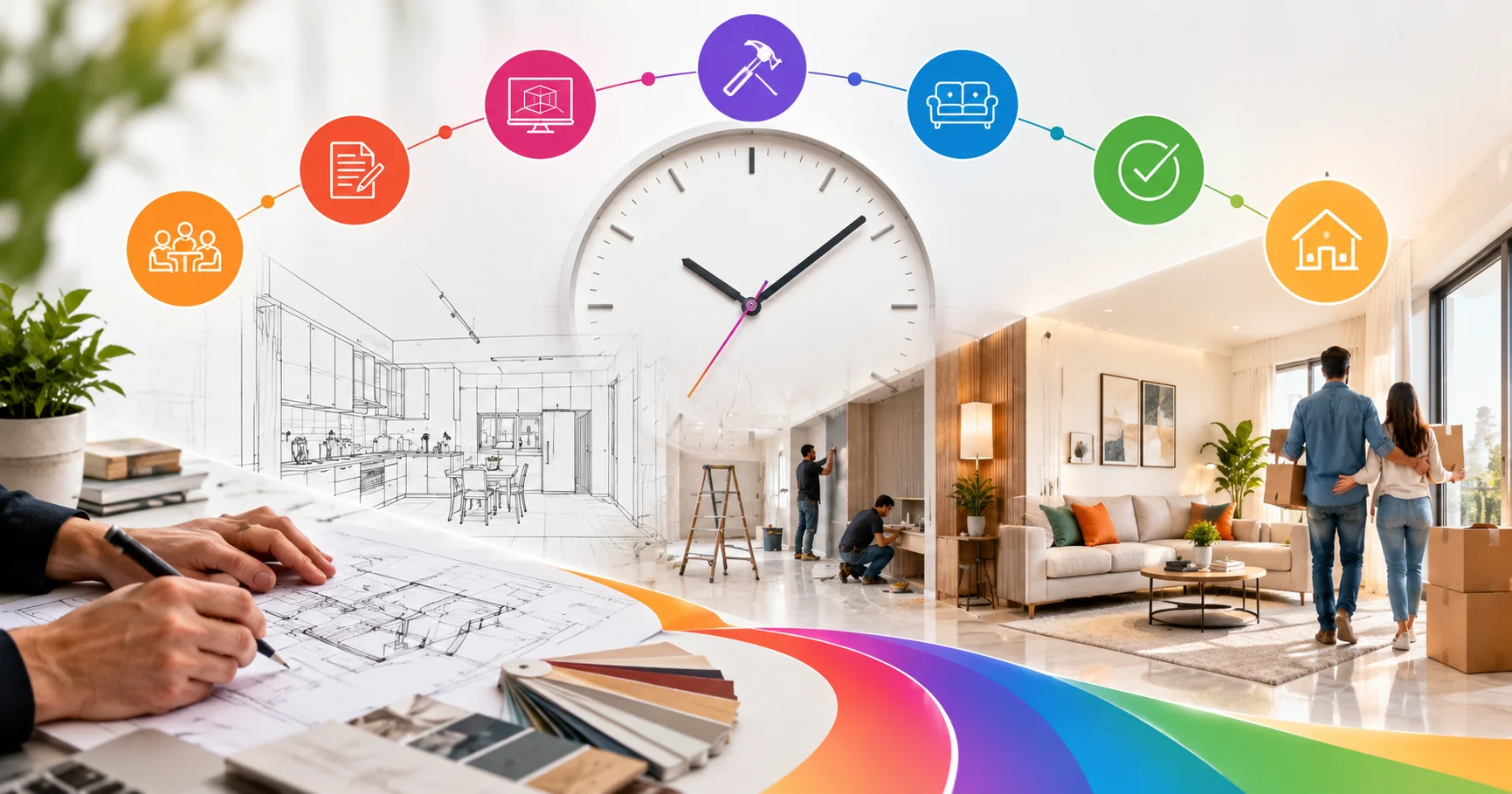
If you're planning to do interior design, the first thing you probably want to know is: how long is this going to take? It's a fair question. You might be juggling a rental lease, waiting to move in before a certain date, or just tired of living out of boxes and eating dinner off a suitcase.
The honest answer is that a full home interior usually takes anywhere between 3 to 6 months. Bigger homes or projects with a lot of custom work can stretch to 8 months or more. There's no single number that fits every home, because so much depends on the size of your space, how much custom work you want, and how quickly decisions get made along the way. But instead of just throwing a number at you, let's walk through what actually happens at each stage, so you know exactly where your weeks and months are going.
Why Interior Design Timelines Vary So Much
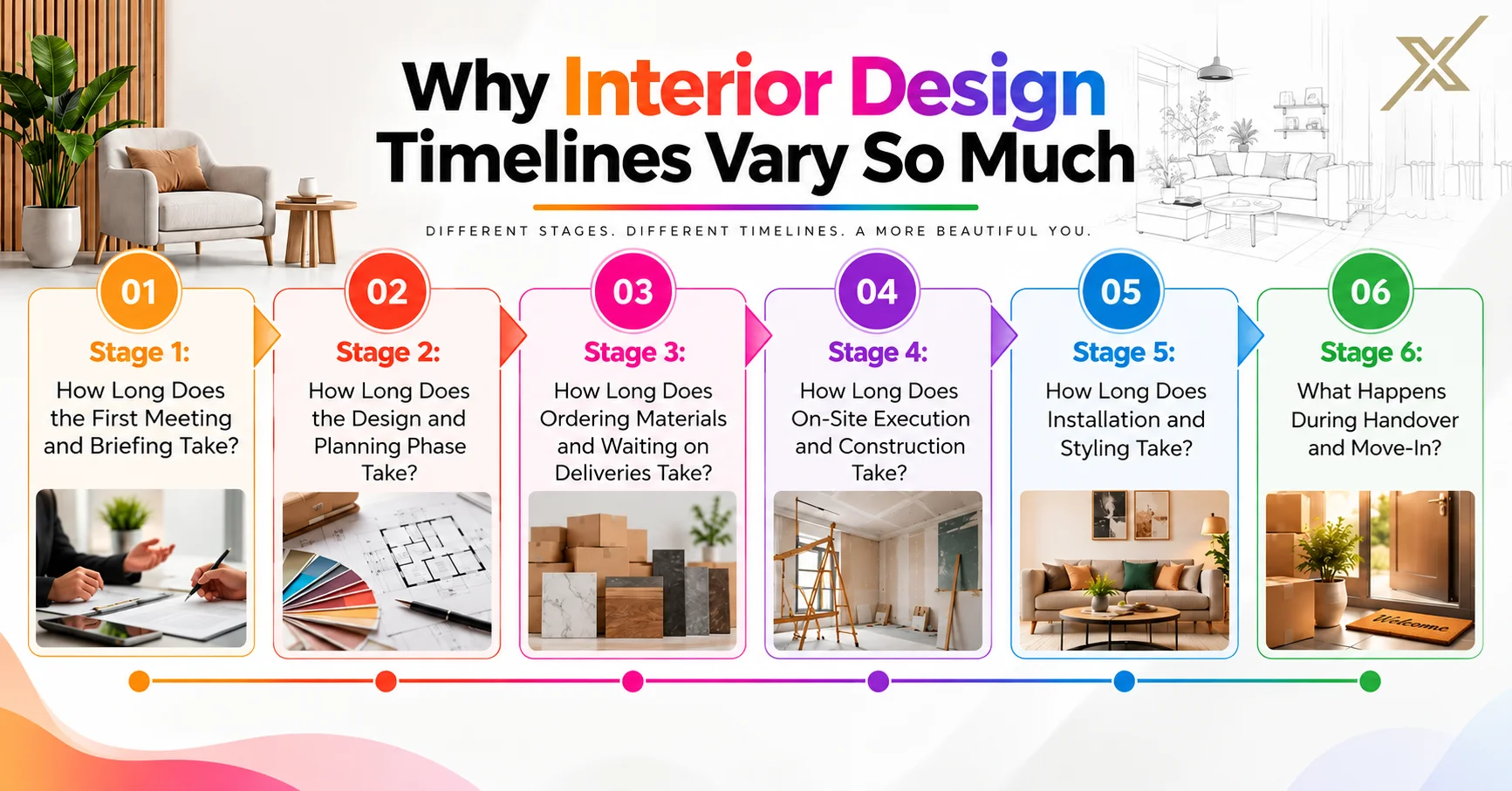
Before we get into the stages, it helps to understand why one person's "3 months" can turn into someone else's "7 months" for what looks like a similar home. A few things drive this difference: the size of your home (a 2BHK will always move faster than a 4BHK or villa), how much custom carpentry you want versus ready-made furniture, how quickly you approve designs and make decisions, and how well the different teams, carpentry, electrical, plumbing, painting, are coordinated on site. Keep these in mind as you read through the stages below, because they'll help you figure out where your own project might land.
Stage 1: How Long Does the First Meeting and Briefing Take?
Time: 1 to 2 weeks
Every project starts with a conversation. This is where you sit down with your designer and talk about how you actually live in your home, do you cook a lot, host guests often, need a work-from-home corner, what's your budget, what look are you going for. A site visit usually happens around this time too, so the team can check the layout, electrical points, plumbing lines, and any structural quirks your home might have.
This stage isn't something to rush. The clearer you are here, the fewer surprises you'll run into later. If you tell your designer upfront that you want a home that works for a joint family, or that storage is your biggest priority, or that you're not a fan of dark colours, it saves everyone a lot of back and forth down the line. Most homeowners spend a week or two on this, going back and forth before things move to paper.
Stage 2: How Long Does the Design and Planning Phase Take?
Time: 3 to 8 weeks
This is where your ideas start taking shape. The design team puts together floor plans, mood boards, colour schemes, furniture layouts, and often a 3D walkthrough so you can picture what your space will look like before a single nail goes in.
Once you're happy with the overall direction, the details get locked in, materials, finishes, hardware, and technical drawings for electrical and civil work. This back-and-forth of tweaking and approving usually takes three to eight weeks, depending on how big your home is and how many rounds of changes you go through.
A quick tip: the faster you approve designs and finalise choices, the faster everything else moves. Most delays at this stage happen because homeowners keep changing their minds on colours, materials, or layouts. It's completely normal to want to see a few options, but try to narrow things down quickly once you've seen enough, every extra round of revisions adds days, sometimes weeks, to your overall timeline.
It also helps to involve everyone who has a say in the decision early on. If your spouse, parents, or anyone else living in the home wants input, bring them into the conversation during this stage rather than after materials have already been ordered.
Stage 3: How Long Does Ordering Materials and Waiting on Deliveries Take?
Time: 4 to 10 weeks
Once your design is locked, it's time to order everything, modular kitchen units, wardrobes, tiles, sanitaryware, lighting, furniture, and all the little fittings that make a house feel like a home.
If you've picked ready-made or in-stock products, this moves fast. But if you've gone with custom carpentry, imported materials, or specific finishes that need to be made to order, expect this to take longer, sometimes up to two and a half months. This part is easy to overlook since nothing is happening at your site yet, but it matters just as much. Good planning here means your site team isn't sitting around waiting for materials once work actually starts.
This is also a good stage to ask questions. Find out from your designer which materials are readily available and which ones need to be specially ordered. If your timeline is tight, sometimes swapping one imported tile or a specific hardware finish for something similar that's already in stock can save you weeks.
Stage 4: How Long Does On-Site Execution and Construction Take?
Time: 8 to 16 weeks
This is the stage most people picture when they think of "interior work" — carpenters on site, electricians running wires, plumbers fixing fittings, and painters giving your walls their final look.
For a standard 2BHK or 3BHK with regular modular work, this usually takes about two to four months. Bigger homes, villas, or projects with heavy custom woodwork and false ceiling design can take longer, sometimes going past four months.
Good coordination matters the most here. When carpentry, electrical, plumbing, and civil teams aren't working in sync, you end up with days where nothing moves forward because one trade is waiting on another to finish. A firm with its own in-house execution team, instead of juggling multiple outside vendors, tends to keep this stage far more predictable, since everyone works off the same schedule and reports to the same project manager.
If you can, try to visit your site every week or two during this stage. Not to micromanage, but just to stay in the loop, catch small issues early, and keep communication open with your site supervisor.
Stage 5: How Long Does Installation and Styling Take?
Time: 1 to 3 weeks
Once the heavy work is done, it's time to bring the space together. Furniture gets placed, lights are fitted, curtains go up, artwork is hung, and all those final touches that make a house feel finished are added.
This part usually moves fast, about one to three weeks, but larger homes or ones with a lot of custom furniture and layered lighting can need a little more time to get every detail right. This is also when you'll notice small adjustments happening, a shelf being repositioned, a light being angled differently, a curtain rod being shifted by an inch, all to get things exactly right.
This stage is honestly one of the most satisfying parts of the whole process. After months of drawings and site visits, this is when your home actually starts looking like the pictures you saw at the very beginning.
Stage 6: What Happens During Handover and Move-In?
Time: A few days to a few weeks
Once everything is installed and styled, your designer will walk you through the home for a final check. This is when any last touch-ups happen, a chip in the paint, a cabinet that needs adjusting, a switch that needs fixing.
Most reputed interior firms also offer a defect liability or aftercare period after handover, where minor issues that show up in the first few weeks or months get fixed free of cost. It's worth asking about this before you sign on, since it gives you peace of mind after you've already moved in.
Before you move in, it's a good idea to go through the home carefully yourself with a checklist, check that every switch works, every drawer slides smoothly, and every door closes properly. Catching these small things early is much easier than fixing them once your belongings are already in place.
So, How Long Does the Whole Interior Design Process Take?
Here's a quick breakdown to give you a realistic picture:
Initial consultation and briefing: 1–2 weeks
Design and planning: 3–8 weeks
Procurement and material lead times: 4–10 weeks
On-site execution: 8–16 weeks
Installation and styling: 1–3 weeks
Handover and move-in: A few days to a few weeks
Add it all up, and a standard 2BHK or 3BHK home usually takes around 3 to 5 months from your first meeting to the day you move in. Larger homes, villas, or projects with a lot of custom work can take 6 to 8 months.
What Speeds Up or Slows Down an Interior Design Timeline?
A few things make a real difference. Quick decision-making on your end, approving designs and materials without long delays, keeps things moving. Choosing in-stock materials over heavily customised ones cuts down waiting time. And working with a firm that handles design and execution under one roof, instead of you coordinating separate vendors yourself, usually means fewer delays and smoother communication.
On the flip side, frequent changes mid-project, unclear briefs at the start, poor coordination between different trades, and last-minute material swaps are what stretch timelines the most. If you're someone who tends to change your mind often, it's worth being extra disciplined during the design stage specifically, since that's where changes cost the least amount of time.
A Few Tips to Keep Your Project on Track
If you want your interior project to move as smoothly as possible, start the process well before your actual move-in deadline, ideally with a buffer of at least a month for unexpected delays. Be decisive during the design phase, since that's the cheapest and fastest place to make changes. Ask your designer for a clear timeline with milestones at the start, so you know what to expect at each stage. And stay in regular touch with your site team, even if it's just a quick weekly check-in, so small issues don't turn into big delays.
Conclusion
Interior design isn't a single event, it's a series of stages that build on each other, and each one needs its own time to be done right. Knowing this timeline helps you plan your move, your budget, and your expectations far better than just hoping for the best.
If you're on the lookout for interior designers in Bangalore who can walk you through this process with clear timelines and honest updates at every stage, it's worth choosing a team that has handled all kinds of homes, from compact 2BHKs to sprawling villas. Working with one of the best interior designers in Bangalore means your project stays organised from day one, and you get to move into a home that's exactly what you pictured, without the stress of guessing how long it'll actually take.
If you're planning to do interior design, the first thing you probably want to know is: how long is this going to take? It's a fair question. You might be juggling a rental lease, waiting to move in before a certain date, or just tired of living out of boxes and eating dinner off a suitcase.
The honest answer is that a full home interior usually takes anywhere between 3 to 6 months. Bigger homes or projects with a lot of custom work can stretch to 8 months or more. There's no single number that fits every home, because so much depends on the size of your space, how much custom work you want, and how quickly decisions get made along the way. But instead of just throwing a number at you, let's walk through what actually happens at each stage, so you know exactly where your weeks and months are going.
Why Interior Design Timelines Vary So Much
Before we get into the stages, it helps to understand why one person's "3 months" can turn into someone else's "7 months" for what looks like a similar home. A few things drive this difference: the size of your home (a 2BHK will always move faster than a 4BHK or villa), how much custom carpentry you want versus ready-made furniture, how quickly you approve designs and make decisions, and how well the different teams, carpentry, electrical, plumbing, painting, are coordinated on site. Keep these in mind as you read through the stages below, because they'll help you figure out where your own project might land.
Stage 1: How Long Does the First Meeting and Briefing Take?
Time: 1 to 2 weeks
Every project starts with a conversation. This is where you sit down with your designer and talk about how you actually live in your home, do you cook a lot, host guests often, need a work-from-home corner, what's your budget, what look are you going for. A site visit usually happens around this time too, so the team can check the layout, electrical points, plumbing lines, and any structural quirks your home might have.
This stage isn't something to rush. The clearer you are here, the fewer surprises you'll run into later. If you tell your designer upfront that you want a home that works for a joint family, or that storage is your biggest priority, or that you're not a fan of dark colours, it saves everyone a lot of back and forth down the line. Most homeowners spend a week or two on this, going back and forth before things move to paper.
Stage 2: How Long Does the Design and Planning Phase Take?
Time: 3 to 8 weeks
This is where your ideas start taking shape. The design team puts together floor plans, mood boards, colour schemes, furniture layouts, and often a 3D walkthrough so you can picture what your space will look like before a single nail goes in.
Once you're happy with the overall direction, the details get locked in, materials, finishes, hardware, and technical drawings for electrical and civil work. This back-and-forth of tweaking and approving usually takes three to eight weeks, depending on how big your home is and how many rounds of changes you go through.
A quick tip: the faster you approve designs and finalise choices, the faster everything else moves. Most delays at this stage happen because homeowners keep changing their minds on colours, materials, or layouts. It's completely normal to want to see a few options, but try to narrow things down quickly once you've seen enough, every extra round of revisions adds days, sometimes weeks, to your overall timeline.
It also helps to involve everyone who has a say in the decision early on. If your spouse, parents, or anyone else living in the home wants input, bring them into the conversation during this stage rather than after materials have already been ordered.
Stage 3: How Long Does Ordering Materials and Waiting on Deliveries Take?
Time: 4 to 10 weeks
Once your design is locked, it's time to order everything, modular kitchen units, wardrobes, tiles, sanitaryware, lighting, furniture, and all the little fittings that make a house feel like a home.
If you've picked ready-made or in-stock products, this moves fast. But if you've gone with custom carpentry, imported materials, or specific finishes that need to be made to order, expect this to take longer, sometimes up to two and a half months. This part is easy to overlook since nothing is happening at your site yet, but it matters just as much. Good planning here means your site team isn't sitting around waiting for materials once work actually starts.
This is also a good stage to ask questions. Find out from your designer which materials are readily available and which ones need to be specially ordered. If your timeline is tight, sometimes swapping one imported tile or a specific hardware finish for something similar that's already in stock can save you weeks.
Stage 4: How Long Does On-Site Execution and Construction Take?
Time: 8 to 16 weeks
This is the stage most people picture when they think of "interior work" — carpenters on site, electricians running wires, plumbers fixing fittings, and painters giving your walls their final look.
For a standard 2BHK or 3BHK with regular modular work, this usually takes about two to four months. Bigger homes, villas, or projects with heavy custom woodwork and false ceiling design can take longer, sometimes going past four months.
Good coordination matters the most here. When carpentry, electrical, plumbing, and civil teams aren't working in sync, you end up with days where nothing moves forward because one trade is waiting on another to finish. A firm with its own in-house execution team, instead of juggling multiple outside vendors, tends to keep this stage far more predictable, since everyone works off the same schedule and reports to the same project manager.
If you can, try to visit your site every week or two during this stage. Not to micromanage, but just to stay in the loop, catch small issues early, and keep communication open with your site supervisor.
Stage 5: How Long Does Installation and Styling Take?
Time: 1 to 3 weeks
Once the heavy work is done, it's time to bring the space together. Furniture gets placed, lights are fitted, curtains go up, artwork is hung, and all those final touches that make a house feel finished are added.
This part usually moves fast, about one to three weeks, but larger homes or ones with a lot of custom furniture and layered lighting can need a little more time to get every detail right. This is also when you'll notice small adjustments happening, a shelf being repositioned, a light being angled differently, a curtain rod being shifted by an inch, all to get things exactly right.
This stage is honestly one of the most satisfying parts of the whole process. After months of drawings and site visits, this is when your home actually starts looking like the pictures you saw at the very beginning.
Stage 6: What Happens During Handover and Move-In?
Time: A few days to a few weeks
Once everything is installed and styled, your designer will walk you through the home for a final check. This is when any last touch-ups happen, a chip in the paint, a cabinet that needs adjusting, a switch that needs fixing.
Most reputed interior firms also offer a defect liability or aftercare period after handover, where minor issues that show up in the first few weeks or months get fixed free of cost. It's worth asking about this before you sign on, since it gives you peace of mind after you've already moved in.
Before you move in, it's a good idea to go through the home carefully yourself with a checklist, check that every switch works, every drawer slides smoothly, and every door closes properly. Catching these small things early is much easier than fixing them once your belongings are already in place.
So, How Long Does the Whole Interior Design Process Take?
Here's a quick breakdown to give you a realistic picture:
Initial consultation and briefing: 1–2 weeks
Design and planning: 3–8 weeks
Procurement and material lead times: 4–10 weeks
On-site execution: 8–16 weeks
Installation and styling: 1–3 weeks
Handover and move-in: A few days to a few weeks
Add it all up, and a standard 2BHK or 3BHK home usually takes around 3 to 5 months from your first meeting to the day you move in. Larger homes, villas, or projects with a lot of custom work can take 6 to 8 months.
What Speeds Up or Slows Down an Interior Design Timeline?
A few things make a real difference. Quick decision-making on your end, approving designs and materials without long delays, keeps things moving. Choosing in-stock materials over heavily customised ones cuts down waiting time. And working with a firm that handles design and execution under one roof, instead of you coordinating separate vendors yourself, usually means fewer delays and smoother communication.
On the flip side, frequent changes mid-project, unclear briefs at the start, poor coordination between different trades, and last-minute material swaps are what stretch timelines the most. If you're someone who tends to change your mind often, it's worth being extra disciplined during the design stage specifically, since that's where changes cost the least amount of time.
A Few Tips to Keep Your Project on Track
If you want your interior project to move as smoothly as possible, start the process well before your actual move-in deadline, ideally with a buffer of at least a month for unexpected delays. Be decisive during the design phase, since that's the cheapest and fastest place to make changes. Ask your designer for a clear timeline with milestones at the start, so you know what to expect at each stage. And stay in regular touch with your site team, even if it's just a quick weekly check-in, so small issues don't turn into big delays.
Conclusion
Interior design isn't a single event, it's a series of stages that build on each other, and each one needs its own time to be done right. Knowing this timeline helps you plan your move, your budget, and your expectations far better than just hoping for the best.
If you're on the lookout for interior designers in Bangalore who can walk you through this process with clear timelines and honest updates at every stage, it's worth choosing a team that has handled all kinds of homes, from compact 2BHKs to sprawling villas. Working with one of the best interior designers in Bangalore means your project stays organised from day one, and you get to move into a home that's exactly what you pictured, without the stress of guessing how long it'll actually take.
Let's
Build
something
enduring
Every exceptional space begins with a conversation. We'd be honored to learn about your vision.
Let's
Build
something
enduring
Every exceptional space begins with a conversation. We'd be honored to learn about your vision.
Let's
Build
something
enduring
Every exceptional space begins with a conversation. We'd be honored to learn about your vision.