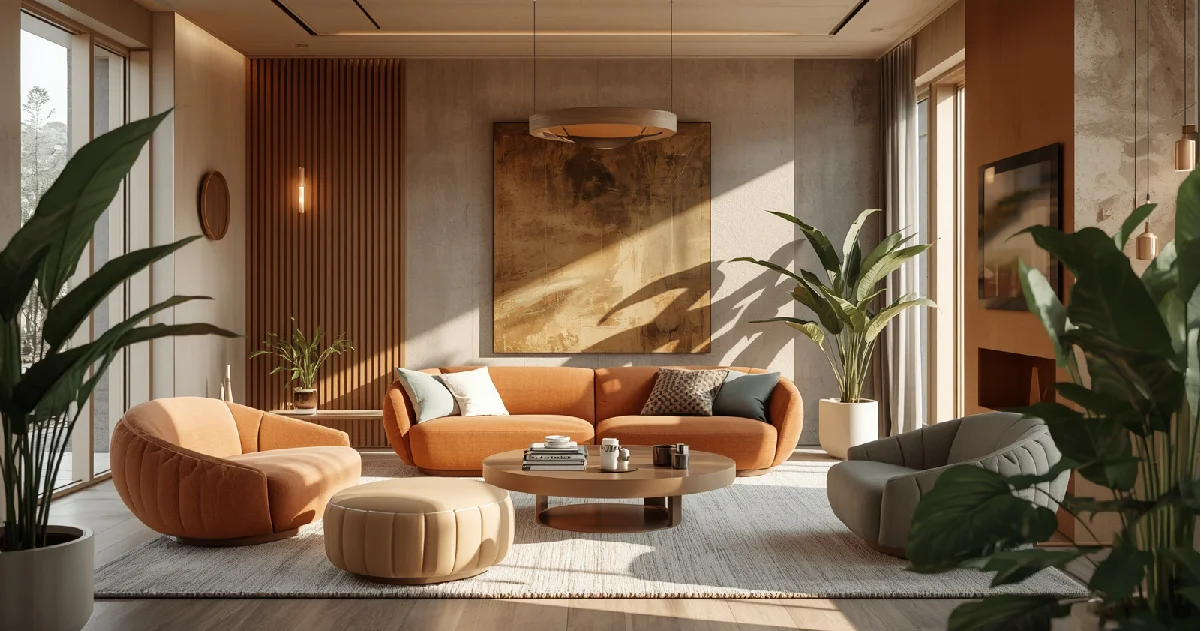
Every year, design publications publish their trend lists, and every year, half the things on them feel like they're written for someone living in a loft in Copenhagen, not a 2 BHK in Sarjapur. So this piece is an attempt to do it differently, bring the global conversation home, filter it through a Bangalore lens, and talk honestly about what's actually worth your attention.
Because if you're planning a home makeover, a full interior fit-out, or even just thinking about freshening up your living room, knowing what's trending isn't about chasing the moment. It's about making choices that will still feel good two or three years down the line.
Here's where design is going in 2026, and more importantly, why it matters to you.
What’s Changing in Interior Design Trends?
Minimalism isn't dead, but it's changing. The crisp, all-white, keep-nothing-on-the-counter aesthetic that dominated through most of the 2010s is losing ground to something warmer, a little messier in a good way, and more personal.
The other big undercurrent: function is catching up with form. Especially in Bangalore, where apartments are getting more expensive per square foot and hybrid work has become permanent for a large share of the population, how a space actually works day-to-day matters more than ever.
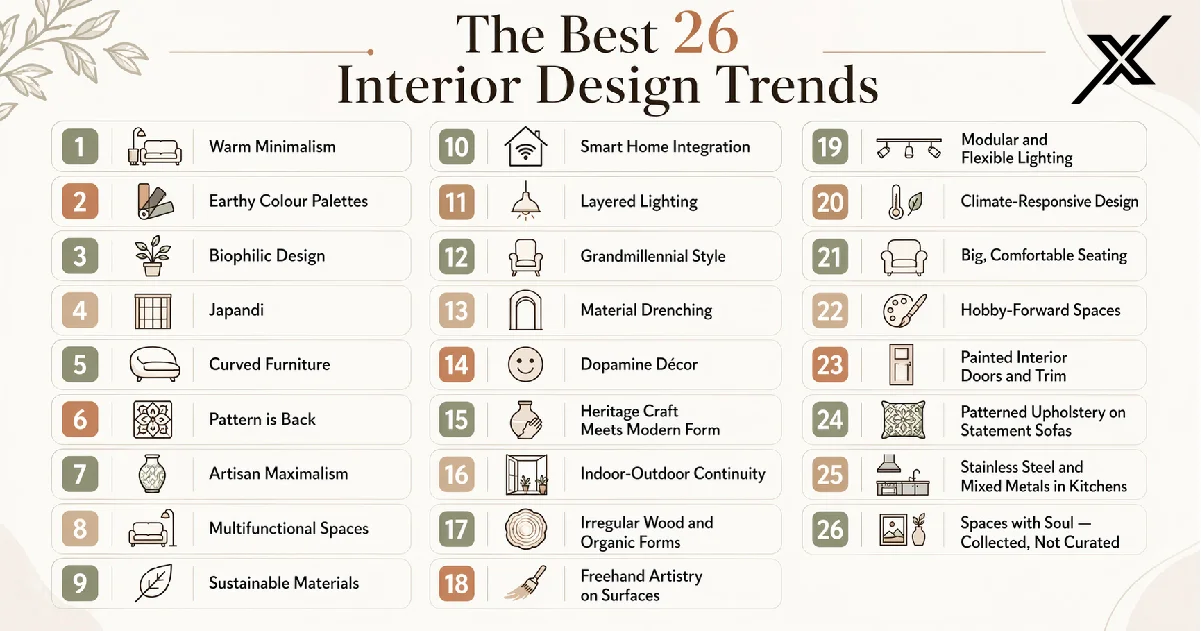
The Best 26 Interior Design Trends
1. Warm Minimalism
Stark white walls, chrome fixtures, nothing on any surface. That look had its moment. In 2026, minimalism is getting softer; think warm beige, clay tones, linen textures, and wooden surfaces that you'd actually want to touch. The restraint is still there, but the coldness is gone.
For Bangalore apartments, this works beautifully. The palette of warm whites with a terracotta accent wall or a wooden shelf lined with a few carefully chosen things, that's the sweet spot. You're not cluttering, but you're also not living in a hotel lobby.
2. Earthy Colour Palettes
Grey has had a remarkable run. It's not over, but it's definitely on notice. The colours taking centre stage in 2026 are ochre, olive green, deep terracotta, warm sand, muted mustard, and the whole warm end of the spectrum. Pantone's 2025 Colour of the Year, Mocha Mousse (a rich, deep brown), basically kicked this off, and deep chocolates and espresso tones are flowing naturally from it.
These colours don't make a room feel small the way a misapplied dark colour can. Used on a feature wall, in upholstery, or even on kitchen cabinet fronts, they add a grounded, settled quality that grey never quite managed.
3. Biophilic Design
Biophilic design, the idea of bringing the natural world into interiors, has been building for years, but in 2026, it's going beyond the obvious. Yes, indoor plants are everywhere. But the deeper trend is about materials: raw stone, unfinished wood, jute, cane, terracotta, and natural linen. It's about texture as much as greenery.
In Bangalore specifically, this makes practical sense. The city's climate is temperate enough to support indoor plants without constant struggle. A home with a few large-leafed plants, wooden furniture, and stone-finish tiles doesn't just look good; it genuinely feels more calming. There's actual research behind that, not just designer opinion.
4. Japandi
Japandi, the blend of Japanese minimalism and Scandinavian coziness, showed up on every trend list for 2024 and 2025, too, and there's a good reason it's still here. It works, especially for Indian apartments where space isn't generous.
The hallmarks: clean lines, natural materials, muted tones, furniture that sits low, and a general sense of intentionality. Nothing decorative that isn't also functional. Nothing functional that isn't also beautiful. It's a philosophy, not just a style, and that's probably why it has more staying power than most trends.
5. Curved Furniture
Sharp corners are giving way. Sofas with rounded armrests, coffee tables with organic edges, and dining chairs that almost look like sculptures, 2026 is decidedly curvy in its furniture choices.
Part of it is practical: rounded furniture genuinely feels more welcoming in a living room and less hazardous in a home with kids. Part of it is aesthetic: a room full of right angles can feel tense in a way that's hard to explain. Introducing one or two curved pieces breaks that up without requiring a complete redesign.
6. Pattern is Back
For a while, the pattern felt risky. Solid colours were safe. In 2026, designers are confidently bringing patterns back, including florals, stripes, geometric prints, and abstract motifs. Not in a maximalist throw-everything-at-the-wall way, but thoughtfully. A patterned sofa against plain walls. A bold printed rug under a simple dining table.
The old rule that patterns overwhelm small spaces is being quietly retired. A well-chosen pattern in a compact Bangalore flat can actually make the space feel richer and more interesting, not smaller.
7. Artisan Maximalism
There's a real appetite right now for things that couldn't have been made by a machine, block-printed textiles, hand-thrown pottery, carved wood panels, metal inlay work, and handwoven rugs. The interest is partly aesthetic (handmade objects have a character that mass-produced ones simply don't have) and partly a response to years of interiors that looked like they were assembled from a single online catalogue.
For Bangalore homeowners, this is an especially good trend to pay attention to. India has extraordinary craft traditions, and sourcing artisan pieces — whether from local markets, from Karnataka's own craft heritage, or from national artisan platforms — supports real makers while giving your home something genuinely unique.
8. Multifunctional Spaces
The home office era isn't over. But we've moved past the phase of just shoving a desk into a corner. In 2026, multifunctional spaces are more sophisticated: guest rooms that convert properly to a study, living rooms with built-in storage that make it easy to transition from family space to work mode, and kitchens with islands that double as dining tables.
In a typical Bangalore 2 or 3 BHK, this kind of thinking at the planning stage makes an enormous difference. A closet, a closet that folds out into a proper workstation, isn't a gimmick. For many people, it's the difference between a productive work-from-home setup and constant frustration.
9. Sustainable Materials
Sustainability is becoming less of a value-add and more of a baseline expectation. Homeowners are asking about VOC levels in paints, the sourcing of their wood, and the recyclability of their furniture. Indian woods like teak and sheesham are being chosen specifically because they're durable, locally sourced, and built to last decades rather than years.
For interior design decisions, this has practical implications. Choosing a solid wood piece over an MDF-and-laminate alternative typically costs more upfront but lasts significantly longer, which is both more sustainable and often more economical in the long run.
10. Smart Home Integration
Smart home technology has been 'the future of interiors' for about a decade now, and it's finally settling into something more mature. The 2026 version of smart home integration is less about impressing guests and more about quiet convenience: lighting systems that adjust automatically with the time of day, climate control that learns your schedule, and motorized window treatments that close before the afternoon sun turns the living room into an oven.
Bangalore's weather, which can swing from pleasant to blazing and back to cool in a single day, makes temperature management genuinely relevant. Smart AC systems that respond to actual conditions rather than timers can meaningfully improve daily comfort.
11. Layered Lighting
One overhead light in every room is a design mistake that's finally being widely acknowledged. 2026 is about layered lighting: ambient light for general illumination, task lighting for specific activities, accent lighting to highlight textures or architectural features, and some decorative lighting that's there primarily because it looks interesting.
Sculptural pendant lights, floor lamps with interesting silhouettes, and LED strips used subtly, these transform how a room feels at night. And in Bangalore, where natural light can be limited in many apartment configurations, good artificial lighting design isn't a luxury; it's a necessity.
12. Grandmillennial Style — Granny Chic, Genuinely Refreshed
"Grandmillennial" design, which sounds more condescending than it is, refers to interiors that embrace pattern, ornamentation, and a kind of warm nostalgia without tipping into clutter. Think embroidered cushions, floral prints, pleated lampshades, chintz upholstery, but paired with contemporary furniture silhouettes.
Done well, it's genuinely charming. Done badly, it looks like someone's grandparents' drawing room before the renovation. The key is one or two statement pieces with the vintage character, surrounded by more contemporary elements.
13. Material Drenching
Material drenching is what happens when you stop treating materials as accents and start treating them as a design system. Imagine a bedroom where all the surfaces, walls, headboard, and bedside tables are in the same marble-effect finish. Or a kitchen where the backsplash, countertop, and island are all in the same natural stone.
It sounds intense, but the effect is often unexpectedly cohesive and calming. It's the material version of a monochrome outfit. And for smaller spaces, it can actually make the room feel more expansive, not more crowded.
14. Dopamine Décor
Not everyone is ready for the warm neutrals conversation. And that's fine. Dopamine décor is for the people who want their home to spark actual joy, vivid blues, sunshine yellows, citrus greens, coral. Used deliberately, these colours are energising rather than exhausting.
The practical approach: use bold colour in a room where the mood you're trying to create is one of energy and happiness — a children's room, a home studio, a dining area where you want gatherings to feel festive. Ground it with neutral furniture and let the color do the work.
15. Heritage Craft Meets Modern Form
This is a distinctly Indian version of a global trend. While designers in New York and London are experimenting with 'handcrafted-feeling' decor, India already has centuries of craft tradition to draw from. Dhokra brass work, Rajasthani blue pottery, Karnataka's own rosewood carving, Channapatna toys as decorative objects, these are beautiful, specific, and genuinely irreplaceable as design elements.
The shift in 2026 is that homeowners are moving from treating these as token 'ethnic' additions to actually building rooms around them. A carved wood panel doesn't have to sit next to a brass elephant to be Indian. It can sit next to a minimal white sofa, and it will be more striking for it.
16. Indoor-Outdoor Continuity
Bangalore's climate makes this trend more relevant here than in most Indian cities. When the weather cooperates (which in Bangalore, it often does), the ideal is a home that flows naturally from indoor to outdoor, a balcony that feels like an extension of the living room, not just a space to put the drying rack.
This means consistent flooring materials that carry across the threshold, similar colour palettes, and outdoor furniture that's actually comfortable. For terrace-level homes or ground-floor apartments with gardens, the possibilities are significant.
17. Irregular Wood and Organic Forms
Perfectly symmetrical, machined furniture is becoming less interesting to people. Irregular wood, pieces where the natural grain is highlighted, where edges are left slightly raw, where the form follows the material rather than fighting it, is gaining ground significantly.
This connects to the broader handmade moment, but it's specifically about wood. A live-edge dining table or a console with a curved, natural edge isn't trying to look effortless; it actually is the natural form of the material. There's an honesty to it that feels right alongside the current appetite for things that are genuinely rather than performatively authentic.
18. Freehand Artistry on Surfaces
Hand-painted walls are coming back, but not in the geometric mural-painting-class way. In 2026, the aesthetic is looser, big brushstrokes, layered colour, surfaces where you can see that a human hand moved. It's intentionally imperfect, and that's the point.
This extends to ceramics, textiles, and even furniture surfaces. The commercial version of this is starting to appear in more mainstream homewares, but the most compelling versions are still one-offs done by actual artists. If you know any local ceramic artists or painters in Bangalore, this might be the year to commission something.
19. Modular and Flexible Lighting
Lighting systems in 2026 are becoming more like furniture — adaptable, rearrangeable, responsive. Modular pendant systems that can be reconfigured, lighting tracks that allow fixtures to be moved, and smart controls that let you change colour temperature and intensity based on what the room needs at that moment.
For Indian homes, where a room might function as a dining room during dinner and a homework space an hour later, the ability to shift the lighting mood without replacing anything is genuinely useful.
20. Climate-Responsive Design
Passive cooling, cross-ventilation, low-VOC finishes, energy-efficient lighting — these are becoming standard considerations rather than add-ons. For Bangalore specifically, where summers are getting progressively warmer, designing a home that stays cooler without relying entirely on air conditioning is both practical and increasingly economical.
This means paying attention to window placement during renovation or fit-out, choosing materials that don't absorb heat, and using natural ventilation intelligently. It's not glamorous, but it significantly affects how comfortable a home feels for nine months of the year.
21. Big, Comfortable Seating
Sofas are getting bigger. Not longer necessarily, but deeper — designed for actually sinking into rather than perching on. The overstuffed, rounded sectional has become something of a cultural symbol for a certain kind of comfort-first design, and it's everywhere in 2026 trend forecasts.
This is partly a pandemic hangover: once you've spent serious time working, eating, watching, and socialising from your sofa, you develop strong opinions about whether it's actually comfortable. The design world is responding.
22. Hobby-Forward Spaces
One of the more interesting design shifts of the last few years: people are designing rooms around what they actually do at home. Not just the idealized Pinterest version of their lives, but the actual activities. A wall of bookshelves for the person who really reads. A proper music corner with instrument storage and acoustic consideration. A dedicated space for the card game nights or the Sunday painting session.
This sounds straightforward, but it's a meaningful departure from interiors that were designed to look good in photographs rather than be lived in. It asks a different question: what does this person actually need their home to do?
23. Painted Interior Doors and Trim
Walls are getting all the colour attention, but in 2026, the trend is extending to doors and trim, painted in a contrasting or complementary colour to the room. A deep green door in an otherwise neutral hallway. Black trim on white walls. Terracotta door frames in a cream room.
It's a relatively low-commitment way to introduce colour and it has a dramatic effect disproportionate to the effort involved. For a rented apartment where you can't paint the walls, this can be a workaround that still makes a statement.
24. Patterned Upholstery on Statement Sofas
The all-grey sofa had a long run. In 2026, sofas are arriving in stripes, florals, geometric prints, and abstract patterns. This is partly possible because the rest of the room's colour palette has simplified, a patterned sofa against plain walls and a textured rug actually works.
The practical argument for a patterned sofa: it hides wear better than a solid, and it gives you more design flexibility because you've already established a colour story from the dominant piece. Start there and build the room around it.
25. Stainless Steel and Mixed Metals in Kitchens
Kitchen design is moving beyond the pure white-and-wood or all-matte-black aesthetics. Brushed stainless steel is making a considered return, particularly for kitchen countertops, backsplashes, and shelving. It's durable, extremely easy to maintain, and in a working kitchen, genuinely practical.
Mixing metals more broadly, combining brass fixtures with chrome fittings or matte black handles with brushed gold taps, is now standard advice from most designers. It used to be that everything had to match. Now the mix is the point, as long as there's some intention behind it.
26. Spaces with Soul — Collected, Not Curated
This is perhaps the broadest and most important shift of 2026. The prevailing aesthetic of the previous decade — interiors that looked like they were styled for a photoshoot, with everything matching and nothing out of place — is being replaced by something more human. Homes that look like they've been assembled over time, where each piece has a reason for being there.
A shelf with a mix of old family photographs, travel finds, a few good books, and a plant doesn't photograph as cleanly as a row of matching white vases. But it tells a story, and increasingly, that's what people want their homes to do.
A Note Specifically for Bangalore Homeowners
A lot of global trend coverage misses the specifics of our context. Bangalore's climate is one of the most design-friendly in India, mild enough for natural ventilation to work most of the year, cool enough at night to not need heavy insulation. That means biophilic elements, indoor-outdoor continuity, and climate-responsive design aren't just aesthetic choices here; they're practical ones that will make your home more comfortable day-to-day.
Space is the other constraint that defines design choices in Bangalore. The city's apartment market has pushed most homeowners into 2 and 3 BHK configurations where multifunctionality, smart storage, and clever layout planning matter enormously. Trends like the cloffice, modular furniture, and multifunctional spaces aren't just fashionable — they address a real problem that most Bangaloreans are dealing with.
And finally, material quality. In a city where most interior work still involves local vendors and contractors, the pressure to cut costs by choosing cheaper materials is constant. The sustainable materials and solid wood furniture trends are, in this context, also a quality argument. A teak console table built properly in Bangalore will outlast three generations of MDF alternatives. That's not nostalgia, that's a financial argument.
Conclusion
The common thread running through almost all of 2026's interior design trends is a move toward authenticity, homes that look and feel like the people who live in them chose everything deliberately, that are comfortable in a genuine rather than a staged way, and that prioritise materials and craft over the kind of fast-fashion mentality that gave us a decade of matching laminate everything.
For Bangalore homeowners, that shift feels natural. This is a city with a design-aware population, strong access to good materials and skilled craftspeople, and a climate that rewards thoughtful decisions about ventilation, light, and space. The trends are pointing in a direction that suits the city.
Finding interior designers in Bangalore who can actually match your expectations is tough. Because everyone claims to be the best, but in reality, the best residential interior designers in Bangalore don't make noise; they show the work, the design, and the pattern, and we at Craftxspace do the same.
Every year, design publications publish their trend lists, and every year, half the things on them feel like they're written for someone living in a loft in Copenhagen, not a 2 BHK in Sarjapur. So this piece is an attempt to do it differently, bring the global conversation home, filter it through a Bangalore lens, and talk honestly about what's actually worth your attention.
Because if you're planning a home makeover, a full interior fit-out, or even just thinking about freshening up your living room, knowing what's trending isn't about chasing the moment. It's about making choices that will still feel good two or three years down the line.
Here's where design is going in 2026, and more importantly, why it matters to you.
What’s Changing in Interior Design Trends?
Minimalism isn't dead, but it's changing. The crisp, all-white, keep-nothing-on-the-counter aesthetic that dominated through most of the 2010s is losing ground to something warmer, a little messier in a good way, and more personal.
The other big undercurrent: function is catching up with form. Especially in Bangalore, where apartments are getting more expensive per square foot and hybrid work has become permanent for a large share of the population, how a space actually works day-to-day matters more than ever.
The Best 26 Interior Design Trends
1. Warm Minimalism
Stark white walls, chrome fixtures, nothing on any surface. That look had its moment. In 2026, minimalism is getting softer; think warm beige, clay tones, linen textures, and wooden surfaces that you'd actually want to touch. The restraint is still there, but the coldness is gone.
For Bangalore apartments, this works beautifully. The palette of warm whites with a terracotta accent wall or a wooden shelf lined with a few carefully chosen things, that's the sweet spot. You're not cluttering, but you're also not living in a hotel lobby.
2. Earthy Colour Palettes
Grey has had a remarkable run. It's not over, but it's definitely on notice. The colours taking centre stage in 2026 are ochre, olive green, deep terracotta, warm sand, muted mustard, and the whole warm end of the spectrum. Pantone's 2025 Colour of the Year, Mocha Mousse (a rich, deep brown), basically kicked this off, and deep chocolates and espresso tones are flowing naturally from it.
These colours don't make a room feel small the way a misapplied dark colour can. Used on a feature wall, in upholstery, or even on kitchen cabinet fronts, they add a grounded, settled quality that grey never quite managed.
3. Biophilic Design
Biophilic design, the idea of bringing the natural world into interiors, has been building for years, but in 2026, it's going beyond the obvious. Yes, indoor plants are everywhere. But the deeper trend is about materials: raw stone, unfinished wood, jute, cane, terracotta, and natural linen. It's about texture as much as greenery.
In Bangalore specifically, this makes practical sense. The city's climate is temperate enough to support indoor plants without constant struggle. A home with a few large-leafed plants, wooden furniture, and stone-finish tiles doesn't just look good; it genuinely feels more calming. There's actual research behind that, not just designer opinion.
4. Japandi
Japandi, the blend of Japanese minimalism and Scandinavian coziness, showed up on every trend list for 2024 and 2025, too, and there's a good reason it's still here. It works, especially for Indian apartments where space isn't generous.
The hallmarks: clean lines, natural materials, muted tones, furniture that sits low, and a general sense of intentionality. Nothing decorative that isn't also functional. Nothing functional that isn't also beautiful. It's a philosophy, not just a style, and that's probably why it has more staying power than most trends.
5. Curved Furniture
Sharp corners are giving way. Sofas with rounded armrests, coffee tables with organic edges, and dining chairs that almost look like sculptures, 2026 is decidedly curvy in its furniture choices.
Part of it is practical: rounded furniture genuinely feels more welcoming in a living room and less hazardous in a home with kids. Part of it is aesthetic: a room full of right angles can feel tense in a way that's hard to explain. Introducing one or two curved pieces breaks that up without requiring a complete redesign.
6. Pattern is Back
For a while, the pattern felt risky. Solid colours were safe. In 2026, designers are confidently bringing patterns back, including florals, stripes, geometric prints, and abstract motifs. Not in a maximalist throw-everything-at-the-wall way, but thoughtfully. A patterned sofa against plain walls. A bold printed rug under a simple dining table.
The old rule that patterns overwhelm small spaces is being quietly retired. A well-chosen pattern in a compact Bangalore flat can actually make the space feel richer and more interesting, not smaller.
7. Artisan Maximalism
There's a real appetite right now for things that couldn't have been made by a machine, block-printed textiles, hand-thrown pottery, carved wood panels, metal inlay work, and handwoven rugs. The interest is partly aesthetic (handmade objects have a character that mass-produced ones simply don't have) and partly a response to years of interiors that looked like they were assembled from a single online catalogue.
For Bangalore homeowners, this is an especially good trend to pay attention to. India has extraordinary craft traditions, and sourcing artisan pieces — whether from local markets, from Karnataka's own craft heritage, or from national artisan platforms — supports real makers while giving your home something genuinely unique.
8. Multifunctional Spaces
The home office era isn't over. But we've moved past the phase of just shoving a desk into a corner. In 2026, multifunctional spaces are more sophisticated: guest rooms that convert properly to a study, living rooms with built-in storage that make it easy to transition from family space to work mode, and kitchens with islands that double as dining tables.
In a typical Bangalore 2 or 3 BHK, this kind of thinking at the planning stage makes an enormous difference. A closet, a closet that folds out into a proper workstation, isn't a gimmick. For many people, it's the difference between a productive work-from-home setup and constant frustration.
9. Sustainable Materials
Sustainability is becoming less of a value-add and more of a baseline expectation. Homeowners are asking about VOC levels in paints, the sourcing of their wood, and the recyclability of their furniture. Indian woods like teak and sheesham are being chosen specifically because they're durable, locally sourced, and built to last decades rather than years.
For interior design decisions, this has practical implications. Choosing a solid wood piece over an MDF-and-laminate alternative typically costs more upfront but lasts significantly longer, which is both more sustainable and often more economical in the long run.
10. Smart Home Integration
Smart home technology has been 'the future of interiors' for about a decade now, and it's finally settling into something more mature. The 2026 version of smart home integration is less about impressing guests and more about quiet convenience: lighting systems that adjust automatically with the time of day, climate control that learns your schedule, and motorized window treatments that close before the afternoon sun turns the living room into an oven.
Bangalore's weather, which can swing from pleasant to blazing and back to cool in a single day, makes temperature management genuinely relevant. Smart AC systems that respond to actual conditions rather than timers can meaningfully improve daily comfort.
11. Layered Lighting
One overhead light in every room is a design mistake that's finally being widely acknowledged. 2026 is about layered lighting: ambient light for general illumination, task lighting for specific activities, accent lighting to highlight textures or architectural features, and some decorative lighting that's there primarily because it looks interesting.
Sculptural pendant lights, floor lamps with interesting silhouettes, and LED strips used subtly, these transform how a room feels at night. And in Bangalore, where natural light can be limited in many apartment configurations, good artificial lighting design isn't a luxury; it's a necessity.
12. Grandmillennial Style — Granny Chic, Genuinely Refreshed
"Grandmillennial" design, which sounds more condescending than it is, refers to interiors that embrace pattern, ornamentation, and a kind of warm nostalgia without tipping into clutter. Think embroidered cushions, floral prints, pleated lampshades, chintz upholstery, but paired with contemporary furniture silhouettes.
Done well, it's genuinely charming. Done badly, it looks like someone's grandparents' drawing room before the renovation. The key is one or two statement pieces with the vintage character, surrounded by more contemporary elements.
13. Material Drenching
Material drenching is what happens when you stop treating materials as accents and start treating them as a design system. Imagine a bedroom where all the surfaces, walls, headboard, and bedside tables are in the same marble-effect finish. Or a kitchen where the backsplash, countertop, and island are all in the same natural stone.
It sounds intense, but the effect is often unexpectedly cohesive and calming. It's the material version of a monochrome outfit. And for smaller spaces, it can actually make the room feel more expansive, not more crowded.
14. Dopamine Décor
Not everyone is ready for the warm neutrals conversation. And that's fine. Dopamine décor is for the people who want their home to spark actual joy, vivid blues, sunshine yellows, citrus greens, coral. Used deliberately, these colours are energising rather than exhausting.
The practical approach: use bold colour in a room where the mood you're trying to create is one of energy and happiness — a children's room, a home studio, a dining area where you want gatherings to feel festive. Ground it with neutral furniture and let the color do the work.
15. Heritage Craft Meets Modern Form
This is a distinctly Indian version of a global trend. While designers in New York and London are experimenting with 'handcrafted-feeling' decor, India already has centuries of craft tradition to draw from. Dhokra brass work, Rajasthani blue pottery, Karnataka's own rosewood carving, Channapatna toys as decorative objects, these are beautiful, specific, and genuinely irreplaceable as design elements.
The shift in 2026 is that homeowners are moving from treating these as token 'ethnic' additions to actually building rooms around them. A carved wood panel doesn't have to sit next to a brass elephant to be Indian. It can sit next to a minimal white sofa, and it will be more striking for it.
16. Indoor-Outdoor Continuity
Bangalore's climate makes this trend more relevant here than in most Indian cities. When the weather cooperates (which in Bangalore, it often does), the ideal is a home that flows naturally from indoor to outdoor, a balcony that feels like an extension of the living room, not just a space to put the drying rack.
This means consistent flooring materials that carry across the threshold, similar colour palettes, and outdoor furniture that's actually comfortable. For terrace-level homes or ground-floor apartments with gardens, the possibilities are significant.
17. Irregular Wood and Organic Forms
Perfectly symmetrical, machined furniture is becoming less interesting to people. Irregular wood, pieces where the natural grain is highlighted, where edges are left slightly raw, where the form follows the material rather than fighting it, is gaining ground significantly.
This connects to the broader handmade moment, but it's specifically about wood. A live-edge dining table or a console with a curved, natural edge isn't trying to look effortless; it actually is the natural form of the material. There's an honesty to it that feels right alongside the current appetite for things that are genuinely rather than performatively authentic.
18. Freehand Artistry on Surfaces
Hand-painted walls are coming back, but not in the geometric mural-painting-class way. In 2026, the aesthetic is looser, big brushstrokes, layered colour, surfaces where you can see that a human hand moved. It's intentionally imperfect, and that's the point.
This extends to ceramics, textiles, and even furniture surfaces. The commercial version of this is starting to appear in more mainstream homewares, but the most compelling versions are still one-offs done by actual artists. If you know any local ceramic artists or painters in Bangalore, this might be the year to commission something.
19. Modular and Flexible Lighting
Lighting systems in 2026 are becoming more like furniture — adaptable, rearrangeable, responsive. Modular pendant systems that can be reconfigured, lighting tracks that allow fixtures to be moved, and smart controls that let you change colour temperature and intensity based on what the room needs at that moment.
For Indian homes, where a room might function as a dining room during dinner and a homework space an hour later, the ability to shift the lighting mood without replacing anything is genuinely useful.
20. Climate-Responsive Design
Passive cooling, cross-ventilation, low-VOC finishes, energy-efficient lighting — these are becoming standard considerations rather than add-ons. For Bangalore specifically, where summers are getting progressively warmer, designing a home that stays cooler without relying entirely on air conditioning is both practical and increasingly economical.
This means paying attention to window placement during renovation or fit-out, choosing materials that don't absorb heat, and using natural ventilation intelligently. It's not glamorous, but it significantly affects how comfortable a home feels for nine months of the year.
21. Big, Comfortable Seating
Sofas are getting bigger. Not longer necessarily, but deeper — designed for actually sinking into rather than perching on. The overstuffed, rounded sectional has become something of a cultural symbol for a certain kind of comfort-first design, and it's everywhere in 2026 trend forecasts.
This is partly a pandemic hangover: once you've spent serious time working, eating, watching, and socialising from your sofa, you develop strong opinions about whether it's actually comfortable. The design world is responding.
22. Hobby-Forward Spaces
One of the more interesting design shifts of the last few years: people are designing rooms around what they actually do at home. Not just the idealized Pinterest version of their lives, but the actual activities. A wall of bookshelves for the person who really reads. A proper music corner with instrument storage and acoustic consideration. A dedicated space for the card game nights or the Sunday painting session.
This sounds straightforward, but it's a meaningful departure from interiors that were designed to look good in photographs rather than be lived in. It asks a different question: what does this person actually need their home to do?
23. Painted Interior Doors and Trim
Walls are getting all the colour attention, but in 2026, the trend is extending to doors and trim, painted in a contrasting or complementary colour to the room. A deep green door in an otherwise neutral hallway. Black trim on white walls. Terracotta door frames in a cream room.
It's a relatively low-commitment way to introduce colour and it has a dramatic effect disproportionate to the effort involved. For a rented apartment where you can't paint the walls, this can be a workaround that still makes a statement.
24. Patterned Upholstery on Statement Sofas
The all-grey sofa had a long run. In 2026, sofas are arriving in stripes, florals, geometric prints, and abstract patterns. This is partly possible because the rest of the room's colour palette has simplified, a patterned sofa against plain walls and a textured rug actually works.
The practical argument for a patterned sofa: it hides wear better than a solid, and it gives you more design flexibility because you've already established a colour story from the dominant piece. Start there and build the room around it.
25. Stainless Steel and Mixed Metals in Kitchens
Kitchen design is moving beyond the pure white-and-wood or all-matte-black aesthetics. Brushed stainless steel is making a considered return, particularly for kitchen countertops, backsplashes, and shelving. It's durable, extremely easy to maintain, and in a working kitchen, genuinely practical.
Mixing metals more broadly, combining brass fixtures with chrome fittings or matte black handles with brushed gold taps, is now standard advice from most designers. It used to be that everything had to match. Now the mix is the point, as long as there's some intention behind it.
26. Spaces with Soul — Collected, Not Curated
This is perhaps the broadest and most important shift of 2026. The prevailing aesthetic of the previous decade — interiors that looked like they were styled for a photoshoot, with everything matching and nothing out of place — is being replaced by something more human. Homes that look like they've been assembled over time, where each piece has a reason for being there.
A shelf with a mix of old family photographs, travel finds, a few good books, and a plant doesn't photograph as cleanly as a row of matching white vases. But it tells a story, and increasingly, that's what people want their homes to do.
A Note Specifically for Bangalore Homeowners
A lot of global trend coverage misses the specifics of our context. Bangalore's climate is one of the most design-friendly in India, mild enough for natural ventilation to work most of the year, cool enough at night to not need heavy insulation. That means biophilic elements, indoor-outdoor continuity, and climate-responsive design aren't just aesthetic choices here; they're practical ones that will make your home more comfortable day-to-day.
Space is the other constraint that defines design choices in Bangalore. The city's apartment market has pushed most homeowners into 2 and 3 BHK configurations where multifunctionality, smart storage, and clever layout planning matter enormously. Trends like the cloffice, modular furniture, and multifunctional spaces aren't just fashionable — they address a real problem that most Bangaloreans are dealing with.
And finally, material quality. In a city where most interior work still involves local vendors and contractors, the pressure to cut costs by choosing cheaper materials is constant. The sustainable materials and solid wood furniture trends are, in this context, also a quality argument. A teak console table built properly in Bangalore will outlast three generations of MDF alternatives. That's not nostalgia, that's a financial argument.
Conclusion
The common thread running through almost all of 2026's interior design trends is a move toward authenticity, homes that look and feel like the people who live in them chose everything deliberately, that are comfortable in a genuine rather than a staged way, and that prioritise materials and craft over the kind of fast-fashion mentality that gave us a decade of matching laminate everything.
For Bangalore homeowners, that shift feels natural. This is a city with a design-aware population, strong access to good materials and skilled craftspeople, and a climate that rewards thoughtful decisions about ventilation, light, and space. The trends are pointing in a direction that suits the city.
Finding interior designers in Bangalore who can actually match your expectations is tough. Because everyone claims to be the best, but in reality, the best residential interior designers in Bangalore don't make noise; they show the work, the design, and the pattern, and we at Craftxspace do the same.
Let's
Build
something
enduring
Every exceptional space begins with a conversation. We'd be honored to learn about your vision.
Let's
Build
something
enduring
Every exceptional space begins with a conversation. We'd be honored to learn about your vision.
Let's
Build
something
enduring
Every exceptional space begins with a conversation. We'd be honored to learn about your vision.