
Confused between a labour contract and a turnkey construction? This guide breaks down both models, compares costs, risks, and control, and helps you decide which is better for your home or project.
What Is Labour Contract Construction?
In a labour contract model, you, the homeowner or project owner, take charge of everything except the workers. You buy all the materials yourself. You hire a contractor who supplies only the labour: masons, carpenters, electricians, plumbers, and so on. The contractor's job is to get the work done. Yours is to source every tile, every bag of cement, and every wire.
It sounds like more work, and it is. But it also means you have full control over what goes into your home.
What Is Turnkey Construction?
Turnkey is the opposite approach. You hire one contractor or firm, hand over your requirements and budget, and they handle everything: design, materials, labour, execution, and handover. You walk in when it's done and "turn the key."
The contractor is responsible from start to finish. You're largely a stakeholder, not a day-to-day decision-maker.
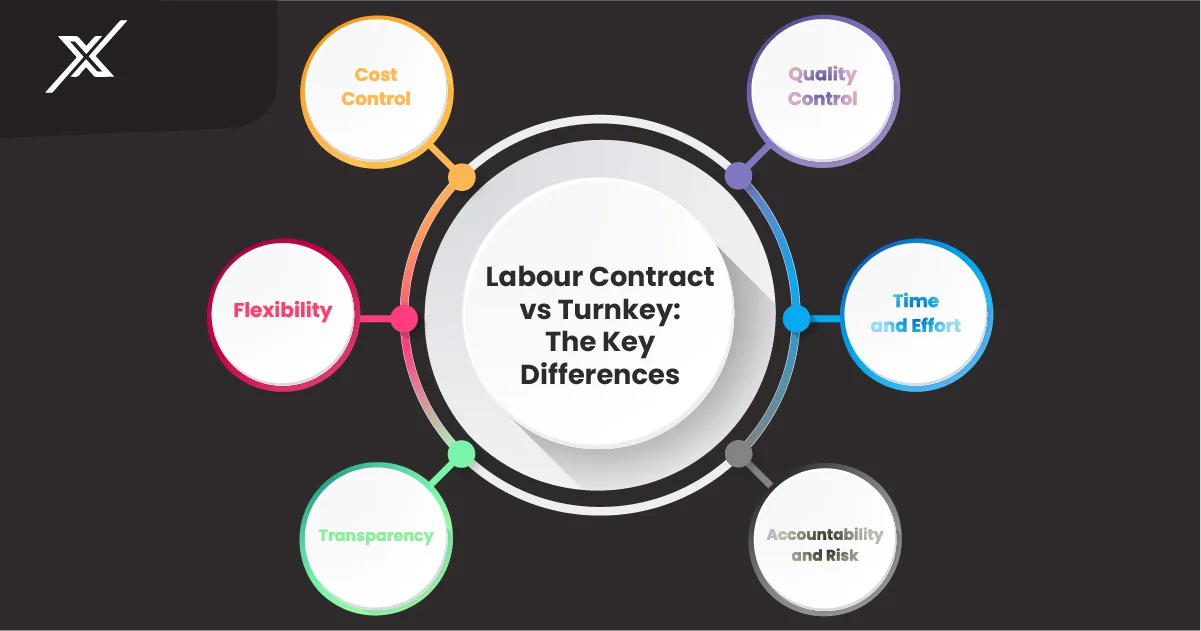
Labour Contract vs Turnkey: The Key Differences
1. Cost Control
Labour contract gives you tighter control over material costs. You can shop around, compare brands, and choose where to spend and where to save. If prices spike mid-project, you absorb the impact, but you also benefit if you find good deals.
With turnkey, the contractor builds a profit margin into material procurement. You pay a consolidated price and won't always know the breakup. Some turnkey firms are transparent; others aren't. Either way, you're paying for convenience.
Verdict: Labour contract is better for cost savings if you have the time and knowledge to manage procurement.
2. Quality Control
This is where labour contract shines, or fails, depending on you. Since you're buying the materials, you control the grade. Want premium tiles in the bathroom and economy-grade ones in the utility? You can do that. But if you're not available to check material delivery or aren't familiar with quality benchmarks, corners can get cut.
In turnkey, quality depends entirely on the firm's standards and the contract terms. A reputable turnkey firm will deliver consistent, documented quality. A less scrupulous one may substitute materials without your knowledge.
Verdict: Turnkey is safer for quality consistency, but only if you choose the right firm and have a detailed contract.
3. Time and Effort
Labour contract is time-intensive for the owner. You'll be coordinating vendors, following up on deliveries, managing workers, and making dozens of micro-decisions. If you're a first-time builder or have a demanding job, this can become overwhelming quickly.
Turnkey construction is designed for people who want to stay hands-off. One point of contact, one timeline, one accountability chain. You review milestones, approve designs, and check the end result.
Verdict: Turnkey wins on convenience. Labour contract suits people who want, and have time, to stay involved.
4. Accountability and Risk
With labour contracts, the contractor is only responsible for what their workers do, not for material delays or quality issues. If tiles crack because you bought the wrong grade, that's on you. Dispute resolution is messier because responsibility is split.
In a turnkey, the contractor owns the entire project. If something goes wrong, delayed delivery, leaking plumbing, or bad finishing, they're accountable. This single-point accountability is a significant advantage, especially for large projects.
Verdict: Turnkey carries lower risk for the owner from an accountability standpoint.
5. Transparency
Labour contracts are naturally transparent because you're buying materials directly. You see every invoice, every price, every vendor. There are no hidden markups.
Turnkey contracts can lack transparency unless the firm provides itemised quotations. Many homeowners sign off on a lump sum without knowing exactly how it's being spent. This becomes a problem if disputes arise later.
Verdict: Labour contract is more transparent by default. For turnkey, insist on a detailed, itemised quote before signing.
6. Flexibility
Want to change the kitchen layout midway through? In labour contracts, adjustments are easier to accommodate because you're managing the process. You can pause, pivot, re-source.
Turnkey changes mid-project usually come with extra charges and timeline extensions. Contractors price in a buffer for change requests, and mid-project alterations can create friction.
Verdict: Labour contract offers more flexibility during execution.
When to Choose Labour Contract
You have any experience with construction or home renovation
You have reliable contacts for material vendors
You're building in phases and want to control spending
You or a trusted person can be present on-site regularly
The project scope is relatively simple
When to Choose Turnkey Construction
You're building or renovating for the first time
You live in a different city or can't supervise daily
You want predictable timelines and consolidated billing
The project is large or complex (full home construction, commercial fit-out)
You're working with a firm that has a strong track record and clear contracts
A Note on Interior Design Projects
For interior design specifically, many firms now offer turnkey interior packages, especially in cities like Bangalore, where the demand for end-to-end solutions is high. This is different from a turnkey construction. Interior turnkey covers everything from space planning and material selection to furniture, soft furnishings, and final styling.
The advantage here is that firms with in-house execution teams (rather than outsourced labour) deliver significantly better results on both quality and timelines. Always ask whether the execution team is in-house or subcontracted before signing.
Cost Comparison Between Labour Contract and Turnkey Construction
Cost Factor | Labour Contract | Turnkey Construction |
Material Cost | Market price (you buy directly) | Marked up 10–20% by contractor |
Labour Cost | Paid separately per trade | Bundled into total project cost |
Design/Planning Fees | Paid separately to architect/designer | Usually included in package |
Project Management | Your responsibility (no cost, but your time) | Included in contractor's fee |
Supervision Cost | You supervise or hire a separate PMC | Handled by contractor |
Wastage & Buffer | You control and absorb | Built into contractor's quote |
Contingency Budget | 10–15% extra kept aside by owner | Pre-factored into lump sum |
Vendor Margins | Zero, you buy direct | Contractor earns margin on every vendor |
Overall Cost (per sq ft — Bangalore approx.) | ₹1,400 – ₹1,800 (basic to mid) | ₹1,800 – ₹2,500+ (basic to mid) |
Interior Fit-Out (per sq ft) | ₹800 – ₹1,200 (materials + labour split) | ₹1,200 – ₹2,000 (end-to-end package) |
Cost Predictability | Low — fluctuates with market rates | High — fixed or semi-fixed quote |
Risk of Cost Overrun | High (owner bears all price risk) | Low-Medium (contractor absorbs most) |
Payment Structure | Pay-as-you-go (materials + labour separately) | Milestone-based (advance + stages) |
Advance Payment Required | Low — typically 10–15% to labour contractor | Higher — typically 25–40% upfront |
Tax / GST Handling | Owner manages multiple vendor GST bills | Single GST invoice from contractor |
Hidden Costs | Material delays, re-orders, quality rejection | Change request charges, scope additions |
Savings Potential | High — 15–25% cheaper if managed well | Low — convenience comes at a premium |
Best For | Experienced owners with time to manage | First-time owners wanting fixed budgets |
Conclusion
There's no universal answer to which model is better; it depends on your situation, capacity, and risk appetite.
If you have the knowledge, time, and hands-on involvement to manage a project, labour contract gives you more control and can be more cost-efficient. You're essentially acting as your own project manager.
If you'd rather hand over the reins to one accountable party and receive a finished space, then turnkey is the smarter, lower-stress option, provided you do your homework on the contractor, read the contract carefully, and insist on transparent pricing. There are many construction companies in Bangalore who provide all these services at a reasonable price, but finding the best construction company in Bangalore is a task.
For most homeowners undertaking a first build or major renovation, turnkey construction, with the right firm, is generally the safer and more practical choice.
Confused between a labour contract and a turnkey construction? This guide breaks down both models, compares costs, risks, and control, and helps you decide which is better for your home or project.
What Is Labour Contract Construction?
In a labour contract model, you, the homeowner or project owner, take charge of everything except the workers. You buy all the materials yourself. You hire a contractor who supplies only the labour: masons, carpenters, electricians, plumbers, and so on. The contractor's job is to get the work done. Yours is to source every tile, every bag of cement, and every wire.
It sounds like more work, and it is. But it also means you have full control over what goes into your home.
What Is Turnkey Construction?
Turnkey is the opposite approach. You hire one contractor or firm, hand over your requirements and budget, and they handle everything: design, materials, labour, execution, and handover. You walk in when it's done and "turn the key."
The contractor is responsible from start to finish. You're largely a stakeholder, not a day-to-day decision-maker.
Labour Contract vs Turnkey: The Key Differences
1. Cost Control
Labour contract gives you tighter control over material costs. You can shop around, compare brands, and choose where to spend and where to save. If prices spike mid-project, you absorb the impact, but you also benefit if you find good deals.
With turnkey, the contractor builds a profit margin into material procurement. You pay a consolidated price and won't always know the breakup. Some turnkey firms are transparent; others aren't. Either way, you're paying for convenience.
Verdict: Labour contract is better for cost savings if you have the time and knowledge to manage procurement.
2. Quality Control
This is where labour contract shines, or fails, depending on you. Since you're buying the materials, you control the grade. Want premium tiles in the bathroom and economy-grade ones in the utility? You can do that. But if you're not available to check material delivery or aren't familiar with quality benchmarks, corners can get cut.
In turnkey, quality depends entirely on the firm's standards and the contract terms. A reputable turnkey firm will deliver consistent, documented quality. A less scrupulous one may substitute materials without your knowledge.
Verdict: Turnkey is safer for quality consistency, but only if you choose the right firm and have a detailed contract.
3. Time and Effort
Labour contract is time-intensive for the owner. You'll be coordinating vendors, following up on deliveries, managing workers, and making dozens of micro-decisions. If you're a first-time builder or have a demanding job, this can become overwhelming quickly.
Turnkey construction is designed for people who want to stay hands-off. One point of contact, one timeline, one accountability chain. You review milestones, approve designs, and check the end result.
Verdict: Turnkey wins on convenience. Labour contract suits people who want, and have time, to stay involved.
4. Accountability and Risk
With labour contracts, the contractor is only responsible for what their workers do, not for material delays or quality issues. If tiles crack because you bought the wrong grade, that's on you. Dispute resolution is messier because responsibility is split.
In a turnkey, the contractor owns the entire project. If something goes wrong, delayed delivery, leaking plumbing, or bad finishing, they're accountable. This single-point accountability is a significant advantage, especially for large projects.
Verdict: Turnkey carries lower risk for the owner from an accountability standpoint.
5. Transparency
Labour contracts are naturally transparent because you're buying materials directly. You see every invoice, every price, every vendor. There are no hidden markups.
Turnkey contracts can lack transparency unless the firm provides itemised quotations. Many homeowners sign off on a lump sum without knowing exactly how it's being spent. This becomes a problem if disputes arise later.
Verdict: Labour contract is more transparent by default. For turnkey, insist on a detailed, itemised quote before signing.
6. Flexibility
Want to change the kitchen layout midway through? In labour contracts, adjustments are easier to accommodate because you're managing the process. You can pause, pivot, re-source.
Turnkey changes mid-project usually come with extra charges and timeline extensions. Contractors price in a buffer for change requests, and mid-project alterations can create friction.
Verdict: Labour contract offers more flexibility during execution.
When to Choose Labour Contract
You have any experience with construction or home renovation
You have reliable contacts for material vendors
You're building in phases and want to control spending
You or a trusted person can be present on-site regularly
The project scope is relatively simple
When to Choose Turnkey Construction
You're building or renovating for the first time
You live in a different city or can't supervise daily
You want predictable timelines and consolidated billing
The project is large or complex (full home construction, commercial fit-out)
You're working with a firm that has a strong track record and clear contracts
A Note on Interior Design Projects
For interior design specifically, many firms now offer turnkey interior packages, especially in cities like Bangalore, where the demand for end-to-end solutions is high. This is different from a turnkey construction. Interior turnkey covers everything from space planning and material selection to furniture, soft furnishings, and final styling.
The advantage here is that firms with in-house execution teams (rather than outsourced labour) deliver significantly better results on both quality and timelines. Always ask whether the execution team is in-house or subcontracted before signing.
Cost Comparison Between Labour Contract and Turnkey Construction
Cost Factor | Labour Contract | Turnkey Construction |
Material Cost | Market price (you buy directly) | Marked up 10–20% by contractor |
Labour Cost | Paid separately per trade | Bundled into total project cost |
Design/Planning Fees | Paid separately to architect/designer | Usually included in package |
Project Management | Your responsibility (no cost, but your time) | Included in contractor's fee |
Supervision Cost | You supervise or hire a separate PMC | Handled by contractor |
Wastage & Buffer | You control and absorb | Built into contractor's quote |
Contingency Budget | 10–15% extra kept aside by owner | Pre-factored into lump sum |
Vendor Margins | Zero, you buy direct | Contractor earns margin on every vendor |
Overall Cost (per sq ft — Bangalore approx.) | ₹1,400 – ₹1,800 (basic to mid) | ₹1,800 – ₹2,500+ (basic to mid) |
Interior Fit-Out (per sq ft) | ₹800 – ₹1,200 (materials + labour split) | ₹1,200 – ₹2,000 (end-to-end package) |
Cost Predictability | Low — fluctuates with market rates | High — fixed or semi-fixed quote |
Risk of Cost Overrun | High (owner bears all price risk) | Low-Medium (contractor absorbs most) |
Payment Structure | Pay-as-you-go (materials + labour separately) | Milestone-based (advance + stages) |
Advance Payment Required | Low — typically 10–15% to labour contractor | Higher — typically 25–40% upfront |
Tax / GST Handling | Owner manages multiple vendor GST bills | Single GST invoice from contractor |
Hidden Costs | Material delays, re-orders, quality rejection | Change request charges, scope additions |
Savings Potential | High — 15–25% cheaper if managed well | Low — convenience comes at a premium |
Best For | Experienced owners with time to manage | First-time owners wanting fixed budgets |
Conclusion
There's no universal answer to which model is better; it depends on your situation, capacity, and risk appetite.
If you have the knowledge, time, and hands-on involvement to manage a project, labour contract gives you more control and can be more cost-efficient. You're essentially acting as your own project manager.
If you'd rather hand over the reins to one accountable party and receive a finished space, then turnkey is the smarter, lower-stress option, provided you do your homework on the contractor, read the contract carefully, and insist on transparent pricing. There are many construction companies in Bangalore who provide all these services at a reasonable price, but finding the best construction company in Bangalore is a task.
For most homeowners undertaking a first build or major renovation, turnkey construction, with the right firm, is generally the safer and more practical choice.
Let's
Build
something
enduring
Every exceptional space begins with a conversation. We'd be honored to learn about your vision.
Let's
Build
something
enduring
Every exceptional space begins with a conversation. We'd be honored to learn about your vision.
Let's
Build
something
enduring
Every exceptional space begins with a conversation. We'd be honored to learn about your vision.