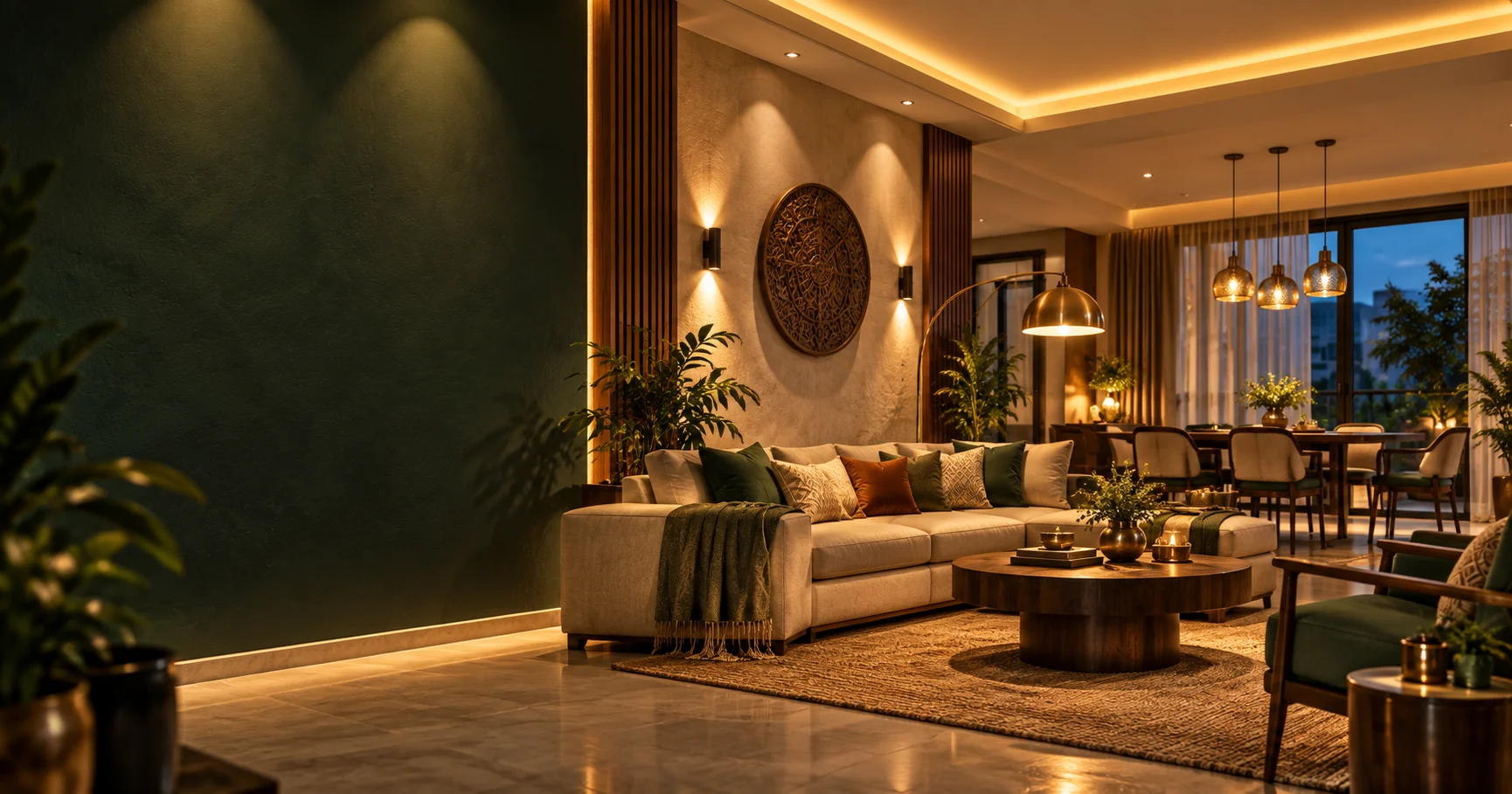
Most Indian homes run on one light per room. Ceiling light on, ceiling light off. That's it. Cooking, studying, watching TV, guests over, same one light the whole time. It's not wrong exactly, it just means the room never really adjusts to what's happening in it.
Layering just means using more than one light and letting each one do a smaller, specific job instead of one light trying to do everything. That's genuinely the whole concept. People make it sound more complicated than it is, mostly because interior sites throw a lot of design language at something that's actually pretty simple once you see it in your own house.
The three types of light
Ambient
Ambient is your main light, the one already in the room, lighting the whole space. Most homes have this covered already, since it's the light that came with the house or the one the electrician put in during construction.
Task light
Task light is for doing something specific, reading, chopping vegetables, working at a desk. It needs to actually point at where you're doing the thing, not just exist somewhere in the room. This is the layer almost every home skips, because it means buying and placing an extra light instead of just using what's already there.
Accent
Accent is the extra one, a small light on a wall, a plant, or a shelf. Doesn't add much brightness, but somehow makes a room look like someone lives there on purpose instead of just moving in and never finishing setting it up. It's also usually the cheapest of the three to add, which makes it a bit odd that it's the one people think about last.
You don't need all three everywhere. Two is fine most of the time. But if a room feels "off" even though the main light works fine, it's usually missing one of these two, and once you add it, you can usually feel exactly what was missing.
Living room
This is the room that suffers most from the one-light habit, mainly because so much different stuff happens here. Watching TV, hosting, kids doing homework on the coffee table, someone scrolling their phone on the sofa at 11pm, one ceiling light can't really serve all of that without being either too much or not enough depending on the hour.
Keep the main light as your base. Dimmer if you can, it's a small cost and genuinely useful, especially if the same room goes from "family dinner" to "everyone just chilling" in the same evening. A lot of homes skip this thinking it's an unnecessary expense, but it ends up being the one upgrade people actually use every single day.
Add a floor lamp near the sofa for whoever reads or works there. Honestly this lamp usually gets used more than people expect once it's there, it becomes the "actual" light for most evenings, while the main ceiling light only comes on when guests are around or the room needs full brightness.
And if there's a wall, a plant, anything worth looking at, put a small light on it. Cheap fix, noticeable difference. Even something as basic as a small LED strip behind a TV unit or a spotlight on a wall-mounted photo frame changes how the room reads at night.
Bedroom
A bedroom under one bright overhead light just doesn't feel like a bedroom. It feels like you're about to get a checkup, or like you walked into a hospital corridor instead of somewhere you're supposed to relax.
Keep the main light warm, dimmer if possible, bright while getting ready, soft once you're winding down. Add a bedside lamp, positioned so it actually lights your book and not your face. Sounds obvious, but most bedside lamps end up wherever the plug point is, not where the light should fall, which is exactly why so many people give up on reading in bed and just scroll their phone instead, the lamp was never actually helping in the first place.
If you and your partner sleep at different times, get separate bedside lights. Solves more small fights than you'd think, no more "turn that off" or "I can't sleep with the light on" arguments every night.
Kitchen
Nobody's trying to make a kitchen "look nice", the point here is just being able to see what you're cutting without guessing.
Keep the ceiling light as base, but the real fix is a light directly over the counter or stove. Your own body blocks the ceiling light more than you realize while cooking, under-cabinet lights fix this instantly, and once you've used one, going back to cooking under just the main light feels like a downgrade.
If there's open shelving or a glass cabinet, one small warm light inside it makes even a basic kitchen look better without any real work involved. This is one of those things that costs very little but somehow makes the whole kitchen feel more finished, especially if you've got steel utensils or glass jars that catch the light nicely.
Dining table
Usually just gets leftover light from the kitchen or living room. A pendant light or small chandelier right above the table changes this more than you'd expect, even an ordinary weekday dinner suddenly feels less random, less like eating wherever there happened to be a chair free.
Just don't hang it too low. People need to see each other, not the bulb. And if the dining table doubles as a study spot for kids in the evening (which happens in a lot of homes), make sure that pendant is actually bright enough for homework, not just moody dinner lighting.
Study or work corner
Whoever's working or studying from home needs an actual desk lamp, not the room's general light. Staring at a laptop or notebook under ambient light for hours is rough on the eyes, and most people just push through it instead of fixing it, assuming eye strain is just part of working from home. One angled desk lamp solves this completely, and it's honestly one of the cheapest fixes on this entire list for how much daily difference it makes.
If the desk is near a window, that helps during the day, but don't assume that covers the evenings too, most work-from-home hours in India stretch well past sunset.
Kids' room
Kids' rooms usually get whatever's easiest to install, mainly because parents are busy setting up the rest of the house, and the kids' room gets whatever's left over. A dimmable main light or a small night light makes the bedtime transition less jarring than flipping straight from bright to pitch dark, which some kids genuinely resist for no other reason than the sudden change.
And if there's a study table, same rule as above, a proper desk lamp, not the room's overhead light, for homework. Kids squinting at homework under a dim general light is more common than most parents realize, simply because nobody thought to add a dedicated lamp.
Pooja corner
Different rules here. Doesn't need to be bright, a soft warm light is enough day to day, and a small spotlight or diya-style light on idols or photos adds warmth without turning the corner into a showroom. No task lighting needed. Nobody's "working" here, and a space meant to feel calm shouldn't be lit like an office.
Balcony
If it's turned into a sit-out spot, a wall light or two for safety plus something like fairy lights or a warm hanging lamp is genuinely all it needs. Don't overthink this one, it's supposed to be a low-effort, low-cost upgrade, not a whole renovation project.
Bathroom
Gets one bright light and that's usually it, which is fine except around the mirror. A light on either side of the mirror, not just overhead, kills the shadows that make shaving or makeup annoying, overhead-only lighting throws shadows under your eyes and chin that make even good lighting elsewhere in the house feel wasted the moment you step in front of the mirror. Small fix, most people never bother, mainly because the bathroom is the last room anyone thinks to upgrade.
If you're renting or can't do any electrical work
A lot of people assume layering means rewiring the house, which isn't true. Plug-in lamps, floor lamps, table lamps, and small plug-in wall lights, cover task and accent lighting without touching a single wire. If you're renting, this is honestly the easier route anyway, since you can take everything with you when you move.
Bulb colour
Warm white generally suits Indian homes better, goes with wood furniture and warmer wall colours most homes already have. The one thing to actually avoid: mixing warm and cool white bulbs in the same room. Looks patchy and unplanned, even if everything else is fine, and it's one of those things that's obvious the second someone points it out but easy to miss otherwise.
Steps to actually do this, room by room
Check what light you already have. Most rooms have ambient sorted, its task and accent that's usually missing.
Sort the main light first. Comfortable brightness, not too harsh. Add a dimmer if the switch allows it.
Think about what actually happens in the room. Not the room's "purpose" on paper, but what you actually do there. Reading, cooking, working, whatever.
Put task lighting exactly where that activity happens. Not near it. Exactly where.
Pick one thing worth highlighting: a wall, a plant, a shelf. That's your accent light spot.
Walk around with all lights on and check if any bulb looks off-tone compared to the rest. Swap it.
Test the room at night, not during the day. Lighting problems mostly show up after dark.
Fix one layer at a time. Don't touch everything at once, usually it's just the task or accent light that needs moving.
Common mistakes to avoid
One light doing everything. Mixed bulb tones without noticing. Bedside lamps are placed badly so they glare. No task lighting in the kitchen, so you're cooking in your own shadow. Skipping dimmers because they seem unnecessary. Ignoring smaller spaces like the study corner or bathroom just because they're not the "main" rooms. And assuming layering means expensive fixtures, when half the fix is just a plug-in lamp in the right spot.
Where to start
Don't redo the whole house at once. Pick the room you're in the most, see what's missing, and add that one layer. Ambient's sorted? Add task lighting. Task lighting done? Add one accent light and see if it changes how the room feels. Once one room clicks, the rest of the house gets easier because you already know what to look for.
Conclusion
Layering isn't about adding more lights for the sake of it, it's about each light actually doing something. Indian homes already juggle a lot in every room, so the lighting should keep up with that instead of staying stuck on one setting all day. Pick one room, add one layer, and you'll notice the difference before you can even explain why.
That said, if you'd rather not figure this out room by room on your own, this is exactly the kind of detail experienced interior designers in Bangalore handle as a matter of routine, knowing which layer a space is missing just by walking into it. And if you're after something a little more considered, a lot of the city's luxury interior designers in Bangalore build this layering in from the start, so the lighting feels planned rather than patched together after the furniture's already in.
Most Indian homes run on one light per room. Ceiling light on, ceiling light off. That's it. Cooking, studying, watching TV, guests over, same one light the whole time. It's not wrong exactly, it just means the room never really adjusts to what's happening in it.
Layering just means using more than one light and letting each one do a smaller, specific job instead of one light trying to do everything. That's genuinely the whole concept. People make it sound more complicated than it is, mostly because interior sites throw a lot of design language at something that's actually pretty simple once you see it in your own house.
The three types of light
Ambient
Ambient is your main light, the one already in the room, lighting the whole space. Most homes have this covered already, since it's the light that came with the house or the one the electrician put in during construction.
Task light
Task light is for doing something specific, reading, chopping vegetables, working at a desk. It needs to actually point at where you're doing the thing, not just exist somewhere in the room. This is the layer almost every home skips, because it means buying and placing an extra light instead of just using what's already there.
Accent
Accent is the extra one, a small light on a wall, a plant, or a shelf. Doesn't add much brightness, but somehow makes a room look like someone lives there on purpose instead of just moving in and never finishing setting it up. It's also usually the cheapest of the three to add, which makes it a bit odd that it's the one people think about last.
You don't need all three everywhere. Two is fine most of the time. But if a room feels "off" even though the main light works fine, it's usually missing one of these two, and once you add it, you can usually feel exactly what was missing.
Living room
This is the room that suffers most from the one-light habit, mainly because so much different stuff happens here. Watching TV, hosting, kids doing homework on the coffee table, someone scrolling their phone on the sofa at 11pm, one ceiling light can't really serve all of that without being either too much or not enough depending on the hour.
Keep the main light as your base. Dimmer if you can, it's a small cost and genuinely useful, especially if the same room goes from "family dinner" to "everyone just chilling" in the same evening. A lot of homes skip this thinking it's an unnecessary expense, but it ends up being the one upgrade people actually use every single day.
Add a floor lamp near the sofa for whoever reads or works there. Honestly this lamp usually gets used more than people expect once it's there, it becomes the "actual" light for most evenings, while the main ceiling light only comes on when guests are around or the room needs full brightness.
And if there's a wall, a plant, anything worth looking at, put a small light on it. Cheap fix, noticeable difference. Even something as basic as a small LED strip behind a TV unit or a spotlight on a wall-mounted photo frame changes how the room reads at night.
Bedroom
A bedroom under one bright overhead light just doesn't feel like a bedroom. It feels like you're about to get a checkup, or like you walked into a hospital corridor instead of somewhere you're supposed to relax.
Keep the main light warm, dimmer if possible, bright while getting ready, soft once you're winding down. Add a bedside lamp, positioned so it actually lights your book and not your face. Sounds obvious, but most bedside lamps end up wherever the plug point is, not where the light should fall, which is exactly why so many people give up on reading in bed and just scroll their phone instead, the lamp was never actually helping in the first place.
If you and your partner sleep at different times, get separate bedside lights. Solves more small fights than you'd think, no more "turn that off" or "I can't sleep with the light on" arguments every night.
Kitchen
Nobody's trying to make a kitchen "look nice", the point here is just being able to see what you're cutting without guessing.
Keep the ceiling light as base, but the real fix is a light directly over the counter or stove. Your own body blocks the ceiling light more than you realize while cooking, under-cabinet lights fix this instantly, and once you've used one, going back to cooking under just the main light feels like a downgrade.
If there's open shelving or a glass cabinet, one small warm light inside it makes even a basic kitchen look better without any real work involved. This is one of those things that costs very little but somehow makes the whole kitchen feel more finished, especially if you've got steel utensils or glass jars that catch the light nicely.
Dining table
Usually just gets leftover light from the kitchen or living room. A pendant light or small chandelier right above the table changes this more than you'd expect, even an ordinary weekday dinner suddenly feels less random, less like eating wherever there happened to be a chair free.
Just don't hang it too low. People need to see each other, not the bulb. And if the dining table doubles as a study spot for kids in the evening (which happens in a lot of homes), make sure that pendant is actually bright enough for homework, not just moody dinner lighting.
Study or work corner
Whoever's working or studying from home needs an actual desk lamp, not the room's general light. Staring at a laptop or notebook under ambient light for hours is rough on the eyes, and most people just push through it instead of fixing it, assuming eye strain is just part of working from home. One angled desk lamp solves this completely, and it's honestly one of the cheapest fixes on this entire list for how much daily difference it makes.
If the desk is near a window, that helps during the day, but don't assume that covers the evenings too, most work-from-home hours in India stretch well past sunset.
Kids' room
Kids' rooms usually get whatever's easiest to install, mainly because parents are busy setting up the rest of the house, and the kids' room gets whatever's left over. A dimmable main light or a small night light makes the bedtime transition less jarring than flipping straight from bright to pitch dark, which some kids genuinely resist for no other reason than the sudden change.
And if there's a study table, same rule as above, a proper desk lamp, not the room's overhead light, for homework. Kids squinting at homework under a dim general light is more common than most parents realize, simply because nobody thought to add a dedicated lamp.
Pooja corner
Different rules here. Doesn't need to be bright, a soft warm light is enough day to day, and a small spotlight or diya-style light on idols or photos adds warmth without turning the corner into a showroom. No task lighting needed. Nobody's "working" here, and a space meant to feel calm shouldn't be lit like an office.
Balcony
If it's turned into a sit-out spot, a wall light or two for safety plus something like fairy lights or a warm hanging lamp is genuinely all it needs. Don't overthink this one, it's supposed to be a low-effort, low-cost upgrade, not a whole renovation project.
Bathroom
Gets one bright light and that's usually it, which is fine except around the mirror. A light on either side of the mirror, not just overhead, kills the shadows that make shaving or makeup annoying, overhead-only lighting throws shadows under your eyes and chin that make even good lighting elsewhere in the house feel wasted the moment you step in front of the mirror. Small fix, most people never bother, mainly because the bathroom is the last room anyone thinks to upgrade.
If you're renting or can't do any electrical work
A lot of people assume layering means rewiring the house, which isn't true. Plug-in lamps, floor lamps, table lamps, and small plug-in wall lights, cover task and accent lighting without touching a single wire. If you're renting, this is honestly the easier route anyway, since you can take everything with you when you move.
Bulb colour
Warm white generally suits Indian homes better, goes with wood furniture and warmer wall colours most homes already have. The one thing to actually avoid: mixing warm and cool white bulbs in the same room. Looks patchy and unplanned, even if everything else is fine, and it's one of those things that's obvious the second someone points it out but easy to miss otherwise.
Steps to actually do this, room by room
Check what light you already have. Most rooms have ambient sorted, its task and accent that's usually missing.
Sort the main light first. Comfortable brightness, not too harsh. Add a dimmer if the switch allows it.
Think about what actually happens in the room. Not the room's "purpose" on paper, but what you actually do there. Reading, cooking, working, whatever.
Put task lighting exactly where that activity happens. Not near it. Exactly where.
Pick one thing worth highlighting: a wall, a plant, a shelf. That's your accent light spot.
Walk around with all lights on and check if any bulb looks off-tone compared to the rest. Swap it.
Test the room at night, not during the day. Lighting problems mostly show up after dark.
Fix one layer at a time. Don't touch everything at once, usually it's just the task or accent light that needs moving.
Common mistakes to avoid
One light doing everything. Mixed bulb tones without noticing. Bedside lamps are placed badly so they glare. No task lighting in the kitchen, so you're cooking in your own shadow. Skipping dimmers because they seem unnecessary. Ignoring smaller spaces like the study corner or bathroom just because they're not the "main" rooms. And assuming layering means expensive fixtures, when half the fix is just a plug-in lamp in the right spot.
Where to start
Don't redo the whole house at once. Pick the room you're in the most, see what's missing, and add that one layer. Ambient's sorted? Add task lighting. Task lighting done? Add one accent light and see if it changes how the room feels. Once one room clicks, the rest of the house gets easier because you already know what to look for.
Conclusion
Layering isn't about adding more lights for the sake of it, it's about each light actually doing something. Indian homes already juggle a lot in every room, so the lighting should keep up with that instead of staying stuck on one setting all day. Pick one room, add one layer, and you'll notice the difference before you can even explain why.
That said, if you'd rather not figure this out room by room on your own, this is exactly the kind of detail experienced interior designers in Bangalore handle as a matter of routine, knowing which layer a space is missing just by walking into it. And if you're after something a little more considered, a lot of the city's luxury interior designers in Bangalore build this layering in from the start, so the lighting feels planned rather than patched together after the furniture's already in.
Let's
Build
something
enduring
Every exceptional space begins with a conversation. We'd be honored to learn about your vision.
Let's
Build
something
enduring
Every exceptional space begins with a conversation. We'd be honored to learn about your vision.
Let's
Build
something
enduring
Every exceptional space begins with a conversation. We'd be honored to learn about your vision.