Modular Kitchen Cost Per Sq. Ft. in Bangalore (2026): Detailed Breakdown
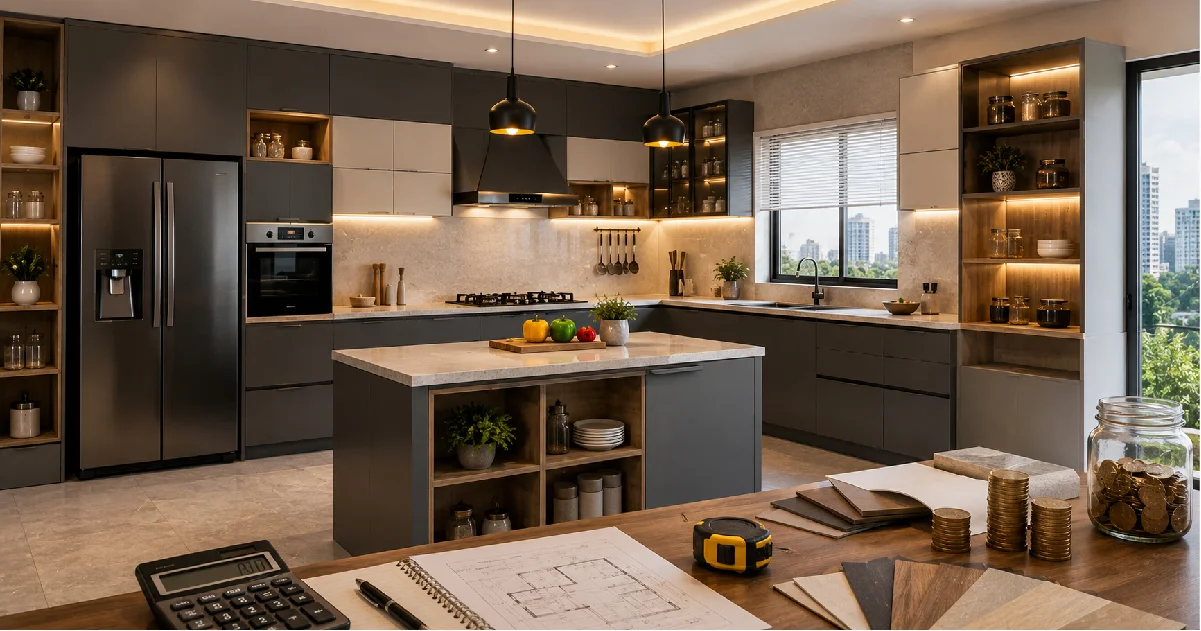
The moment you start planning a modular kitchen, every suggestion looks suspiciously low or absurdly high. Most of the time, the contractor says, "It depends on the material," the showroom tells you about "packages," and you're left trying to do your own math on the drive home.
So here's a detailed breakdown regarding it, not in vague ranges, but with enough detail to help you walk into any vendor conversation in Bangalore with a clearer head.
Per Sq. Ft. Pricing
The per sq. ft. metric is useful but honestly a bit misleading when used in isolation. A modular kitchen isn't just floor space; it involves cabinetry (both base and wall), countertops, backsplashes, a sink, electricals, and all the little hardware pieces that quietly eat into the budget. So when someone gives you a rate per sq. ft., always ask: what exactly is that covering?"
A compact L-shaped kitchen in a 2BHK in Whitefield might be around 45-55 sq. ft. of floor space, but the total cost is calculated across multiple components, not just that area. Keep that in mind throughout everything below.
What are the primary elements that can affect your modular kitchen rate per sq. ft.?
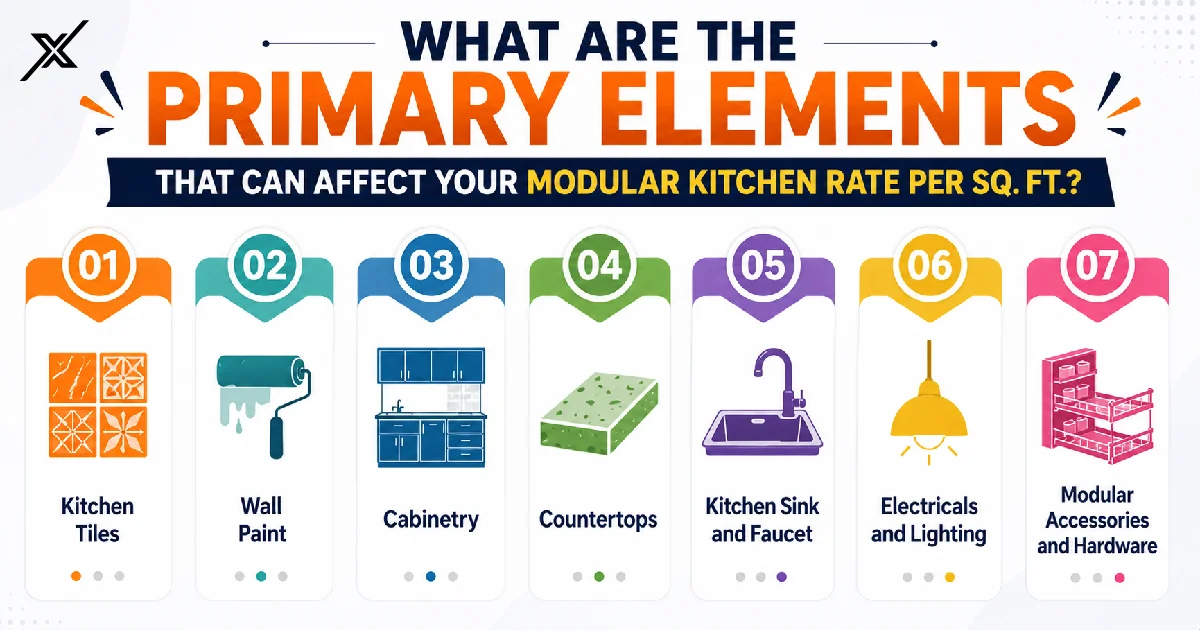
1. Kitchen Tiles
Tiling is one of those costs that comes unexpectedly because they think about just the floor. But you also have the backsplash, the stretch of wall between your countertop and upper cabinets, which can cover anywhere from 15 to 30 sq. ft., depending on your kitchen layout.
Measure both areas, and add about 7–10% extra for wastage. Tiles always break; corners are unforgiving.
What it costs: Tiling and installation start at around ₹150 per sq. ft., though that's the bare entry point. If you want vitrified tiles or anything with a pattern, you're looking at ₹250–₹500 per sq. ft. once material and labor are combined. Minimum billing is typically 50 sq. ft. with most vendors.
2. Wall Paint
If you're doing a full kitchen renovation, you'll likely repaint, either just the kitchen walls or the ceiling, too. Not every kitchen needs a full paint, but in older apartments (pre-2015 construction, especially), the kitchen walls tend to absorb grease and staining that regular cleaning doesn't fully fix.
Premium emulsion paint is the standard recommendation for kitchens because it's easier to wipe down. Acrylic emulsion costs more but holds up better near stoves and sinks.
What it costs: Premium emulsion runs between ₹22 and ₹32 per sq. ft. plus GST. That's wall area, not floor area. Measure your walls only.
3. Cabinetry
This is where your modular kitchen cost comes the most. The cabinet cost depends on two separate choices: the core material (what's inside) and the shutter finish (what you see). Both matter.
Core material options:
MDF (Medium Density Fiberboard): More affordable, holds screws reasonably well, and works fine in dry areas of the kitchen. Gets problematic near sinks if water exposure is frequent.
BWR (Boiling Water Resistant) Plywood: Costs more than MDF, handles moisture better, and feels more solid. Traditional carpenters default to this.
HDHMR (High Density High Moisture Resistant board): Newer in the market, priced between MDF and plywood. Worth considering for Bangalore's semi-humid climate.
What it costs: A single-door base cabinet in a wood laminate finish with an MDF core (600mm width) averages around ₹12,000–₹13,500 per unit. A full kitchen with 8–12 cabinet modules (lower + upper) can put you anywhere between ₹1.8 lakhs and ₹4+ lakhs, depending on the combination of materials and accessories.
4. Countertops
Countertops are both functional and visual. Indian cooking is rough on surfaces: pressure cooking, grinding, and staining from turmeric, so durability matters here more than aesthetics, even if you think it's the other way around at the planning stage.
Material comparison:
Granite: Most commonly used in Bangalore, durable, heat-resistant, and relatively affordable. Grey and black granites (Absolute Black, Silver Galaxy, etc.) are popular. Starts at around ₹570 per sq. ft.
Quartz: Engineered stone, non-porous, consistent appearance. Costs significantly more, typically ₹1,200–₹2,500 per sq. ft. depending on brand and thickness.
Marble: Looks beautiful, but stains easily. Not the best fit for everyday Indian cooking. Usually used selectively for island tops or counter accents.
Synthetic solid surface (e.g., Corian): Seamless finish, hygienic, mid-to-high range pricing. Good for people who hate grout lines.
5. Kitchen Sink and Faucet
The sink choice is straightforward for most Bangalore households; a single-bowl stainless steel sink covers 90% of needs. But if you cook for a large family or have a washing area separate from the kitchen, a double bowl setup makes actual sense (not just aesthetic sense).
Vegetable bowl add-ons are useful; most people who get them end up using them daily.
What it costs: A decent single-bowl stainless steel sink (around 533×437 mm, satin finish) runs about ₹4,500–₹6,500. Add ₹2,000–₹5,000 for a good faucet. If you're going for a granite composite or ceramic undermount sink, budget ₹8,000–₹15,000.
Plumbing work is separate, typically ₹1,500–₹3,000 depending on your site conditions and whether pipework needs rerouting.
6. Electricals and Lighting
This is the cost that's hardest to pin down upfront. It depends on how many plug points you're adding, whether you want under-cabinet lighting (profile lights), chimney wiring, and whether your existing switchboard layout needs to change.
A chimney alone needs a dedicated 15A point. Your refrigerator, microwave, oven, mixer, and water purifier all need separate circuits, ideally, to avoid tripping. In older buildings in Rajajinagar or Basavanagudi, the existing kitchen wiring often doesn't account for modern appliances, which means electricals become a bigger line item than expected.
What it costs: Basic rewiring and point additions for a kitchen renovation typically run ₹8,000–₹20,000. If you add profile lighting under upper cabinets or inside glass-shutter units, add another ₹5,000–₹12,000 depending on the length and quality of the LED strip and driver unit.
7. Modular Accessories and Hardware
This is the category that separates a functional kitchen from a genuinely well-designed one. Pull-out bins, spice drawers, thali baskets, corner carousel units, cutlery trays inside drawers, none of these are luxuries per se, but collectively they can add ₹25,000–₹60,000 to your budget.
The corner problem is real. Dead corners in L-shaped and U-shaped kitchens waste significant storage unless you address them specifically with a carousel, a magic corner unit, or a simple pull-out system. Most budget kitchens just put a cabinet door there and call it done. Most people regret that within six months.
Key accessories to budget for:
Soft-close hinges and drawer channels (worth every rupee, non-negotiable in a good modular kitchen)
Pull-out trash bins (2–3 compartments)
Corner solutions
Cutlery and spice organizers
Tall unit pull-outs or laundry pull-outs if applicable
How Kitchen Layout Affects Total Cost
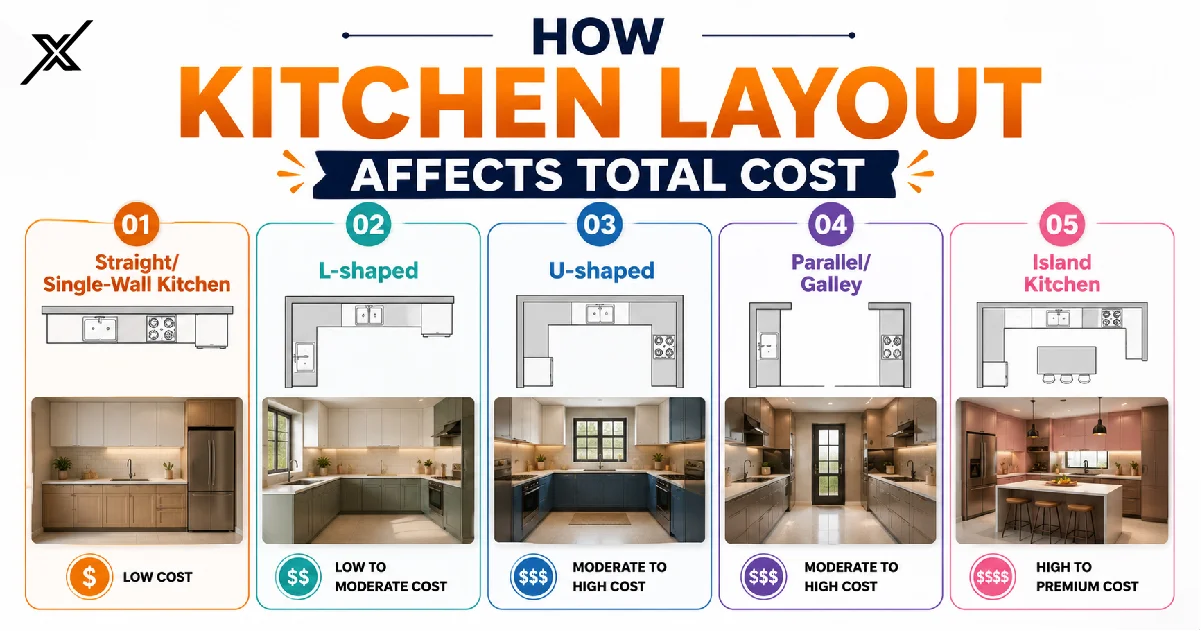
Layout matters more than most people think because it directly affects the number of cabinets, the countertop length, and the complexity of installation.
Straight/single-wall kitchen: Simplest and cheapest. Common in smaller apartments and 1BHKs. Limited storage unless you use a tall unit.
L-shaped: Most common in 2BHKs across Bangalore. Efficient, fits the work triangle well, and gives enough counter space for everyday cooking.
U-shaped: More cabinets, more countertop, more cost. Works well in kitchens with decent floor space (70+ sq. ft.). Great for people who genuinely cook a lot, two separate work zones become practical.
Parallel/galley: Two parallel counters facing each other. Efficient for cooking but requires enough width (minimum 4.5 feet between counters for comfortable movement). Common in older apartments.
Island kitchen: Rare in standard apartments; more relevant for villas and builder-floor homes in areas like Sarjapur or Devanahalli. An island adds high cost, typically ₹80,000–₹200,000 for the unit itself, separate from the main kitchen.
Can You Cut Costs Without Cutting Quality?

Yes, but you have to be selective. Here's where the real trade-offs lie:
Go laminate over acrylic for shutters. Laminate has improved significantly; matte textures and wood-finish laminates look genuinely premium now, and they're far easier to maintain. The cost difference can be ₹30,000–₹70,000 on a full kitchen.
Choose granite over quartz. Unless you have a specific reason for quartz (uniformity in appearance, zero porosity for heavy usage), granite gives you nearly the same durability at a fraction of the cost.
Don't skip soft-close on hardware. This is the one place where skimping backfires. Cabinet hinges and drawer channels that fail after two years cost more to fix than the savings you made upfront.
Reuse existing plumbing and electrical points if possible. If the kitchen layout allows you to keep the sink in roughly the same position and not add new circuits, you save a meaningful amount on civil and electrical work.
Invest in fewer, better accessories. You don't need every organizer in the catalogue. Pick the three or four that solve real problems in your cooking routine and skip the ones that'll just collect dust.
Conclusion
A good modular kitchen is not just about cost and pouring lakhs of money. It’s also about good planning. Many kitchen interior designers in Bangalore can deliver results tailored to your needs within a perfect budget.
Take smart decisions; don’t go generic. Different cities need different kinds of interiors according to the usage, weather, space, and many more things. Interior design in Bangalore asks for all these metrics we have discussed in this article so far.
The moment you start planning a modular kitchen, every suggestion looks suspiciously low or absurdly high. Most of the time, the contractor says, "It depends on the material," the showroom tells you about "packages," and you're left trying to do your own math on the drive home.
So here's a detailed breakdown regarding it, not in vague ranges, but with enough detail to help you walk into any vendor conversation in Bangalore with a clearer head.
Per Sq. Ft. Pricing
The per sq. ft. metric is useful but honestly a bit misleading when used in isolation. A modular kitchen isn't just floor space; it involves cabinetry (both base and wall), countertops, backsplashes, a sink, electricals, and all the little hardware pieces that quietly eat into the budget. So when someone gives you a rate per sq. ft., always ask: what exactly is that covering?"
A compact L-shaped kitchen in a 2BHK in Whitefield might be around 45-55 sq. ft. of floor space, but the total cost is calculated across multiple components, not just that area. Keep that in mind throughout everything below.
What are the primary elements that can affect your modular kitchen rate per sq. ft.?
1. Kitchen Tiles
Tiling is one of those costs that comes unexpectedly because they think about just the floor. But you also have the backsplash, the stretch of wall between your countertop and upper cabinets, which can cover anywhere from 15 to 30 sq. ft., depending on your kitchen layout.
Measure both areas, and add about 7–10% extra for wastage. Tiles always break; corners are unforgiving.
What it costs: Tiling and installation start at around ₹150 per sq. ft., though that's the bare entry point. If you want vitrified tiles or anything with a pattern, you're looking at ₹250–₹500 per sq. ft. once material and labor are combined. Minimum billing is typically 50 sq. ft. with most vendors.
2. Wall Paint
If you're doing a full kitchen renovation, you'll likely repaint, either just the kitchen walls or the ceiling, too. Not every kitchen needs a full paint, but in older apartments (pre-2015 construction, especially), the kitchen walls tend to absorb grease and staining that regular cleaning doesn't fully fix.
Premium emulsion paint is the standard recommendation for kitchens because it's easier to wipe down. Acrylic emulsion costs more but holds up better near stoves and sinks.
What it costs: Premium emulsion runs between ₹22 and ₹32 per sq. ft. plus GST. That's wall area, not floor area. Measure your walls only.
3. Cabinetry
This is where your modular kitchen cost comes the most. The cabinet cost depends on two separate choices: the core material (what's inside) and the shutter finish (what you see). Both matter.
Core material options:
MDF (Medium Density Fiberboard): More affordable, holds screws reasonably well, and works fine in dry areas of the kitchen. Gets problematic near sinks if water exposure is frequent.
BWR (Boiling Water Resistant) Plywood: Costs more than MDF, handles moisture better, and feels more solid. Traditional carpenters default to this.
HDHMR (High Density High Moisture Resistant board): Newer in the market, priced between MDF and plywood. Worth considering for Bangalore's semi-humid climate.
What it costs: A single-door base cabinet in a wood laminate finish with an MDF core (600mm width) averages around ₹12,000–₹13,500 per unit. A full kitchen with 8–12 cabinet modules (lower + upper) can put you anywhere between ₹1.8 lakhs and ₹4+ lakhs, depending on the combination of materials and accessories.
4. Countertops
Countertops are both functional and visual. Indian cooking is rough on surfaces: pressure cooking, grinding, and staining from turmeric, so durability matters here more than aesthetics, even if you think it's the other way around at the planning stage.
Material comparison:
Granite: Most commonly used in Bangalore, durable, heat-resistant, and relatively affordable. Grey and black granites (Absolute Black, Silver Galaxy, etc.) are popular. Starts at around ₹570 per sq. ft.
Quartz: Engineered stone, non-porous, consistent appearance. Costs significantly more, typically ₹1,200–₹2,500 per sq. ft. depending on brand and thickness.
Marble: Looks beautiful, but stains easily. Not the best fit for everyday Indian cooking. Usually used selectively for island tops or counter accents.
Synthetic solid surface (e.g., Corian): Seamless finish, hygienic, mid-to-high range pricing. Good for people who hate grout lines.
5. Kitchen Sink and Faucet
The sink choice is straightforward for most Bangalore households; a single-bowl stainless steel sink covers 90% of needs. But if you cook for a large family or have a washing area separate from the kitchen, a double bowl setup makes actual sense (not just aesthetic sense).
Vegetable bowl add-ons are useful; most people who get them end up using them daily.
What it costs: A decent single-bowl stainless steel sink (around 533×437 mm, satin finish) runs about ₹4,500–₹6,500. Add ₹2,000–₹5,000 for a good faucet. If you're going for a granite composite or ceramic undermount sink, budget ₹8,000–₹15,000.
Plumbing work is separate, typically ₹1,500–₹3,000 depending on your site conditions and whether pipework needs rerouting.
6. Electricals and Lighting
This is the cost that's hardest to pin down upfront. It depends on how many plug points you're adding, whether you want under-cabinet lighting (profile lights), chimney wiring, and whether your existing switchboard layout needs to change.
A chimney alone needs a dedicated 15A point. Your refrigerator, microwave, oven, mixer, and water purifier all need separate circuits, ideally, to avoid tripping. In older buildings in Rajajinagar or Basavanagudi, the existing kitchen wiring often doesn't account for modern appliances, which means electricals become a bigger line item than expected.
What it costs: Basic rewiring and point additions for a kitchen renovation typically run ₹8,000–₹20,000. If you add profile lighting under upper cabinets or inside glass-shutter units, add another ₹5,000–₹12,000 depending on the length and quality of the LED strip and driver unit.
7. Modular Accessories and Hardware
This is the category that separates a functional kitchen from a genuinely well-designed one. Pull-out bins, spice drawers, thali baskets, corner carousel units, cutlery trays inside drawers, none of these are luxuries per se, but collectively they can add ₹25,000–₹60,000 to your budget.
The corner problem is real. Dead corners in L-shaped and U-shaped kitchens waste significant storage unless you address them specifically with a carousel, a magic corner unit, or a simple pull-out system. Most budget kitchens just put a cabinet door there and call it done. Most people regret that within six months.
Key accessories to budget for:
Soft-close hinges and drawer channels (worth every rupee, non-negotiable in a good modular kitchen)
Pull-out trash bins (2–3 compartments)
Corner solutions
Cutlery and spice organizers
Tall unit pull-outs or laundry pull-outs if applicable
How Kitchen Layout Affects Total Cost
Layout matters more than most people think because it directly affects the number of cabinets, the countertop length, and the complexity of installation.
Straight/single-wall kitchen: Simplest and cheapest. Common in smaller apartments and 1BHKs. Limited storage unless you use a tall unit.
L-shaped: Most common in 2BHKs across Bangalore. Efficient, fits the work triangle well, and gives enough counter space for everyday cooking.
U-shaped: More cabinets, more countertop, more cost. Works well in kitchens with decent floor space (70+ sq. ft.). Great for people who genuinely cook a lot, two separate work zones become practical.
Parallel/galley: Two parallel counters facing each other. Efficient for cooking but requires enough width (minimum 4.5 feet between counters for comfortable movement). Common in older apartments.
Island kitchen: Rare in standard apartments; more relevant for villas and builder-floor homes in areas like Sarjapur or Devanahalli. An island adds high cost, typically ₹80,000–₹200,000 for the unit itself, separate from the main kitchen.
Can You Cut Costs Without Cutting Quality?
Yes, but you have to be selective. Here's where the real trade-offs lie:
Go laminate over acrylic for shutters. Laminate has improved significantly; matte textures and wood-finish laminates look genuinely premium now, and they're far easier to maintain. The cost difference can be ₹30,000–₹70,000 on a full kitchen.
Choose granite over quartz. Unless you have a specific reason for quartz (uniformity in appearance, zero porosity for heavy usage), granite gives you nearly the same durability at a fraction of the cost.
Don't skip soft-close on hardware. This is the one place where skimping backfires. Cabinet hinges and drawer channels that fail after two years cost more to fix than the savings you made upfront.
Reuse existing plumbing and electrical points if possible. If the kitchen layout allows you to keep the sink in roughly the same position and not add new circuits, you save a meaningful amount on civil and electrical work.
Invest in fewer, better accessories. You don't need every organizer in the catalogue. Pick the three or four that solve real problems in your cooking routine and skip the ones that'll just collect dust.
Conclusion
A good modular kitchen is not just about cost and pouring lakhs of money. It’s also about good planning. Many kitchen interior designers in Bangalore can deliver results tailored to your needs within a perfect budget.
Take smart decisions; don’t go generic. Different cities need different kinds of interiors according to the usage, weather, space, and many more things. Interior design in Bangalore asks for all these metrics we have discussed in this article so far.
Let's
Build
something
enduring
Every exceptional space begins with a conversation. We'd be honored to learn about your vision.
Let's
Build
something
enduring
Every exceptional space begins with a conversation. We'd be honored to learn about your vision.
Let's
Build
something
enduring
Every exceptional space begins with a conversation. We'd be honored to learn about your vision.