
Suppose you are planning to open a restaurant; the budget breakdown would be one of the biggest worries. And it should be. It’s usually the biggest chunk of money you’ll spend before you sell a single plate of food.
The problem is that nobody gives you a straight answer. Ask three designers and you’ll get three totally different numbers for the same shop. So let’s break it down in plain words: what restaurant interior design costs in India, why the numbers vary so much, and how to plan a budget that doesn’t fall apart halfway.
How Much Does Restaurant Interior Design Cost in India?
Short answer: for interiors only, most restaurants land somewhere between ₹900 and ₹5,000 per sq ft. Yes, that’s a wide range. That’s because “interior” can mean a simple laminate counter and tiles, or imported stone and custom wood panelling.
Here’s a rough picture for 2026:
Budget Level | Cost per Sq Ft (approx.) | What it usually looks like |
Basic | ₹900 to ₹1,500 | Simple tiles, laminate, ready-made chairs and tables, basic lights |
Mid-range | ₹1,500 to ₹2,800 | Some custom seating, nicer lighting, a proper theme |
Premium | ₹2,800 to ₹5,000+ | Stone, veneer, custom furniture, designer lights |
Think of these as a starting point, not a quote. Your city, your shop condition and your design taste can push the number either way.
Interior Cost vs Total Cost
This is where most new owners get burned.
When a designer says “₹1,800 per sq ft”, they usually mean the dining area work: floor, ceiling, walls, furniture, lights. That’s it. The kitchen, exhaust, gas line, fire safety and licences are often separate.
Once you add all that, a full-service restaurant can easily go to ₹2,500 to ₹6,500 per sq ft. Fine dining and bars go even higher.
So before you compare any quotes, ask one question: “Does this include the kitchen and ventilation?” You’ll be surprised how often the answer is no.
Restaurant Interior Cost by Type: Cafe, QSR, Fine Dining
What you’re opening matters more than how big the space is. A rough guide:
Type | Interior Cost per Sq Ft (approx.) | Where most of the money goes |
Cloud kitchen | ₹800 to ₹1,800 | Kitchen, almost nothing on dining decor |
QSR / fast food | ₹1,200 to ₹2,500 | Counters, tough flooring, fast service layout |
Cafe | ₹1,500 to ₹3,000 | Seating, lighting, the “look” people will click photos of |
Casual dining | ₹1,800 to ₹3,500 | Comfortable seating, mood, sound control |
Bar or lounge | ₹2,500 to ₹4,500 | Bar counter, back wall, custom seating |
Fine dining | ₹3,500 to ₹5,500+ | Premium materials, private areas, special lighting |
So a 1,000 sq ft cafe with a decent mid-range look might cost around ₹15 to ₹30 lakh for interiors. A fine dining place of the same size can be double that without much effort.
What Makes the Cost Go Up or Down?
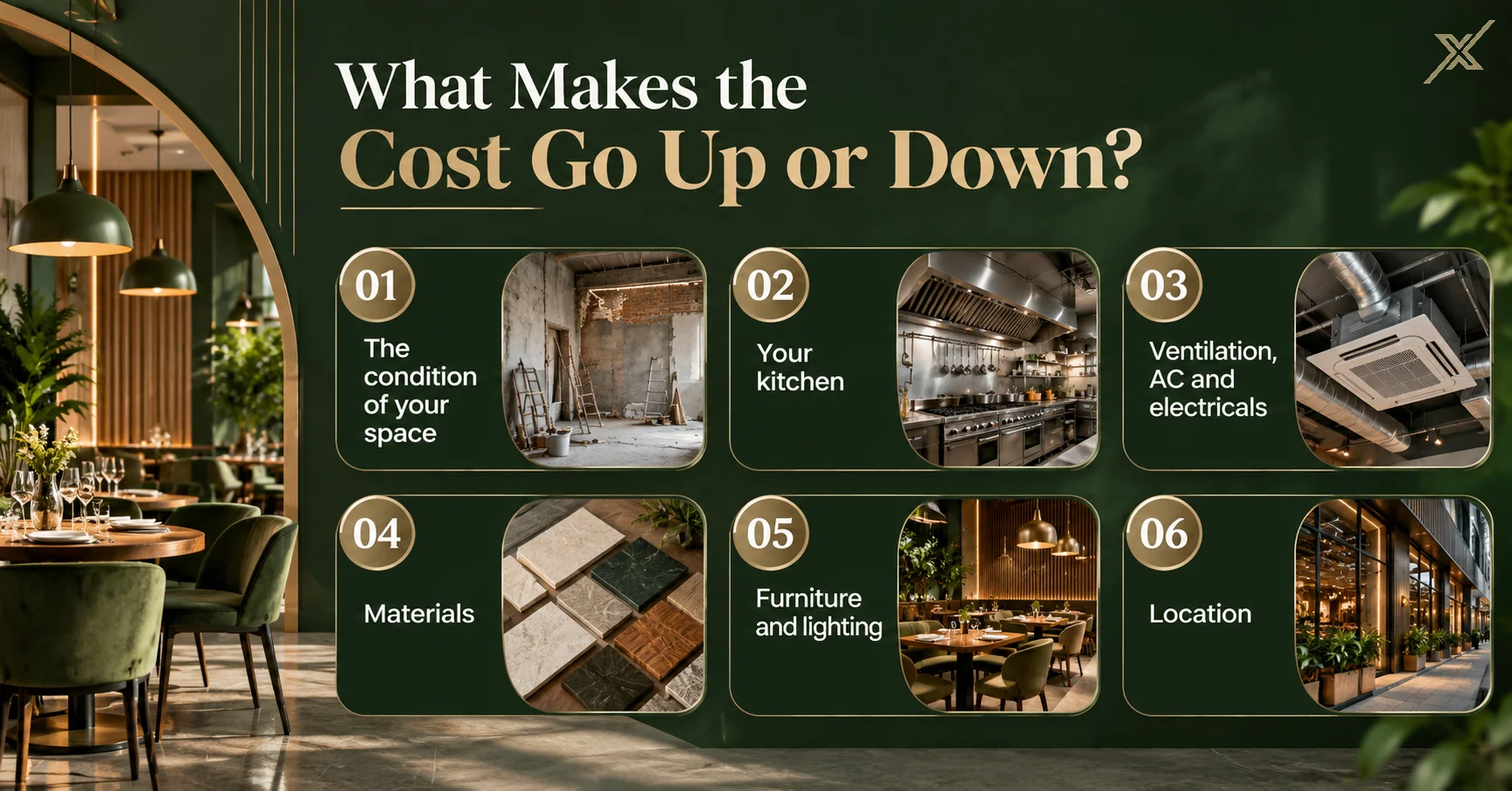
Same size, same city, and two restaurants can still have a 2x price gap. Here’s why.
The condition of your space
If you get a ready shop with water, power and drainage in place, you save a lot. A bare shell means new plumbing, wiring and civil work before the “design” even begins. Many people sign the lease first and think about this later. Don’t.
Your kitchen
Your menu decides your kitchen, not the other way round. A tandoor, a fryer and a bakery section each need different setups. As a thumb rule, the kitchen and everything behind the scenes can eat up 35 to 45 percent of your total project cost. New owners almost always under-budget this.
Ventilation, AC and electricals
Nobody posts photos of exhaust ducts on Instagram, but they can cost more than your entire feature wall. A restaurant kitchen needs proper exhaust and fresh air, or it will be hot, smoky, and unusable.
Materials
Laminate, vitrified tiles and paint keep costs low. Natural stone, veneer and metal work push them up fast. Neither is better or worse. Just know which one your quote is based on.
Furniture and lighting
Chairs, sofas, booths and decorative lights add up quietly. In cafes and lounges, where people sit for hours, this can end up being the highest single cost.
Location
Malls come with strict rules, odd working hours, and heavy deposits. A mall fit-out can cost 10 to 20 percent more than a street-side shop. Metropolitan cities cost more than smaller towns too.
Hidden Costs for Restaurant Interior
This is the part that wrecks budgets. Check if your quote covers these, because many don’t:
Kitchen equipment (burners, ovens, fridges, cold room, dishwasher)
Exhaust hood and ducting
Grease trap and drain changes
Gas pipeline or cylinder bank setup
Fire safety upgrades
Extra power load or a generator
Licences like FSSAI, fire NOC, trade licence, and liquor licence if you need it
POS machine, CCTV, music system
Plates, glasses, cutlery, uniforms
Mall deposits and landlord charges
GST and loan interest
Staff training, trial days and opening marketing
Keep a separate line for each one in your own sheet. If you push them into “other expenses”, you’ll forget them until the bill arrives.
Sample Budget: What a 1,000 Sq Ft Restaurant Might Cost
Let’s make this real. Say you’re opening a mid-range casual restaurant of about 1,000 sq ft. This is just an example to show how the money spreads out, so don’t treat it like a quote.
Item | Approx. Cost |
Dining area interiors | ₹18 to ₹25 lakh |
Kitchen civil work and flooring | ₹5 to ₹8 lakh |
Kitchen equipment and cold storage | ₹12 to ₹20 lakh |
Exhaust and AC | ₹6 to ₹10 lakh |
Signage and branding | ₹2 to ₹4 lakh |
Licences and approvals | ₹1 to ₹3 lakh |
Extra buffer (about 10%) | ₹4 to ₹7 lakh |
Total | ₹48 to ₹77 lakh |
See how the dining area is only a little over a third of the whole spend? That’s the thing most people don’t expect.
Where to Spend and Where to Save
Here’s a simple way to think about it. Put every expense in one of three boxes.
Box 1: Must work
Kitchen layout and equipment
Exhaust and ventilation
Drainage and waterproofing
Safe wiring and gas lines
Non-slip flooring
Good basic lighting
Box 2: Must feel like your brand
The counter
One feature wall or entrance area
Seating style and colours
Signage
Box 3: Can wait
Fancy ceilings
Imported materials
Complicated custom furniture
Anything you can add after opening
If money runs short, cut from Box 3 first. Then a bit from Box 2. Never touch Box 1 unless you have no choice. The classic mistake is doing the opposite, saving on the kitchen to pay for a pretty wall, and then struggling on day one.
10 Ways to Cut Restaurant Interior Cost Without Making It Look Cheap
Decide your budget range and priorities before you meet any designer
Finalise the kitchen with your chef first, then design the dining area
Keep shapes simple and repeat the same design details
Use materials available locally instead of imported ones
Put your money into 2 or 3 spots people notice (entrance, counter, one wall)
Invest in good lighting, since it makes simple interiors look expensive
Buy ready-made furniture for most seats and customise only a few
Plan electrical, AC and plumbing together so nothing gets broken and redone
Compare at least three quotes line by line
Keep 10 to 12 percent aside for surprises, because there will be surprises
The best savings happen before work begins. Once materials are ordered and walls are open, changing your mind gets expensive fast.
How to Compare Quotes the Right Way
Please don’t just look at the final number. A cheaper quote is often cheaper because something is missing. Compare:
What’s included and what’s not
Material brands and quality
Whether kitchen and ventilation are covered
Whether furniture and lights are included
Who handles drawings and approvals
Timeline and payment schedule
Warranty and support after handover
And ask to see real restaurant projects they’ve finished, not just 3D renders. A designer who has done restaurants before understands kitchen flow, grease traps and exhaust. That experience saves you money, even if their quote looks slightly higher.
How Long Does It Take?
Every extra week is rent with no income, so timing matters. For a mid-size restaurant, here’s what’s realistic:
Stage | Approx. Time |
Concept and design | 3 to 5 weeks |
Drawings and cost sheet | 2 to 4 weeks |
Licence applications (done alongside) | 4 to 12 weeks |
Interior construction | 6 to 12 weeks |
Cleaning, testing and handover | 1 to 3 weeks |
All in, plan for 3 to 5 months from signing to opening. Liquor licence and fire approval are the usual reasons for delay, so apply early. Don’t wait for the interiors to finish.
What to Keep Ready Before Asking for a Quote
The clearer your plan, the closer your quote will be to reality. Have these answers ready:
Area in sq ft
Type of restaurant
Bare shell or ready space
Mall or street-side
Number of seats you want
What’s on your menu (this decides the kitchen)
Basic, mid-range or premium look
Your city
Your budget range
When you want to open
Conclusion
There’s no single answer to the restaurant interior design cost in Bangalore. It depends on what you’re opening, the condition of your space, how heavy your kitchen is, and how much you want to spend on the look. Interiors alone can start around ₹900 per sq ft, but once the kitchen, ventilation and licences come in, the full cost goes up a lot.
The easiest way to stay on budget is to keep things simple. Know your priorities, split your spending into must-have, brand look and can-wait, ask for written quotes that clearly list what’s included, and always keep a buffer for surprises.
If you’re planning a restaurant or cafe in the city, your choice of designer matters just as much as your budget. Experienced commercial interior designers in Bangalore already know the local rules, the licence process and the kitchen and exhaust needs that trip up first-time owners. That knowledge saves you both time and money. So take your time, compare a few portfolios, and ask to see real restaurant projects before you decide. The best interior designers in Bangalore won’t just make your space look good. They’ll help you plan every rupee so the restaurant works smoothly from day one.
Suppose you are planning to open a restaurant; the budget breakdown would be one of the biggest worries. And it should be. It’s usually the biggest chunk of money you’ll spend before you sell a single plate of food.
The problem is that nobody gives you a straight answer. Ask three designers and you’ll get three totally different numbers for the same shop. So let’s break it down in plain words: what restaurant interior design costs in India, why the numbers vary so much, and how to plan a budget that doesn’t fall apart halfway.
How Much Does Restaurant Interior Design Cost in India?
Short answer: for interiors only, most restaurants land somewhere between ₹900 and ₹5,000 per sq ft. Yes, that’s a wide range. That’s because “interior” can mean a simple laminate counter and tiles, or imported stone and custom wood panelling.
Here’s a rough picture for 2026:
Budget Level | Cost per Sq Ft (approx.) | What it usually looks like |
Basic | ₹900 to ₹1,500 | Simple tiles, laminate, ready-made chairs and tables, basic lights |
Mid-range | ₹1,500 to ₹2,800 | Some custom seating, nicer lighting, a proper theme |
Premium | ₹2,800 to ₹5,000+ | Stone, veneer, custom furniture, designer lights |
Think of these as a starting point, not a quote. Your city, your shop condition and your design taste can push the number either way.
Interior Cost vs Total Cost
This is where most new owners get burned.
When a designer says “₹1,800 per sq ft”, they usually mean the dining area work: floor, ceiling, walls, furniture, lights. That’s it. The kitchen, exhaust, gas line, fire safety and licences are often separate.
Once you add all that, a full-service restaurant can easily go to ₹2,500 to ₹6,500 per sq ft. Fine dining and bars go even higher.
So before you compare any quotes, ask one question: “Does this include the kitchen and ventilation?” You’ll be surprised how often the answer is no.
Restaurant Interior Cost by Type: Cafe, QSR, Fine Dining
What you’re opening matters more than how big the space is. A rough guide:
Type | Interior Cost per Sq Ft (approx.) | Where most of the money goes |
Cloud kitchen | ₹800 to ₹1,800 | Kitchen, almost nothing on dining decor |
QSR / fast food | ₹1,200 to ₹2,500 | Counters, tough flooring, fast service layout |
Cafe | ₹1,500 to ₹3,000 | Seating, lighting, the “look” people will click photos of |
Casual dining | ₹1,800 to ₹3,500 | Comfortable seating, mood, sound control |
Bar or lounge | ₹2,500 to ₹4,500 | Bar counter, back wall, custom seating |
Fine dining | ₹3,500 to ₹5,500+ | Premium materials, private areas, special lighting |
So a 1,000 sq ft cafe with a decent mid-range look might cost around ₹15 to ₹30 lakh for interiors. A fine dining place of the same size can be double that without much effort.
What Makes the Cost Go Up or Down?
Same size, same city, and two restaurants can still have a 2x price gap. Here’s why.
The condition of your space
If you get a ready shop with water, power and drainage in place, you save a lot. A bare shell means new plumbing, wiring and civil work before the “design” even begins. Many people sign the lease first and think about this later. Don’t.
Your kitchen
Your menu decides your kitchen, not the other way round. A tandoor, a fryer and a bakery section each need different setups. As a thumb rule, the kitchen and everything behind the scenes can eat up 35 to 45 percent of your total project cost. New owners almost always under-budget this.
Ventilation, AC and electricals
Nobody posts photos of exhaust ducts on Instagram, but they can cost more than your entire feature wall. A restaurant kitchen needs proper exhaust and fresh air, or it will be hot, smoky, and unusable.
Materials
Laminate, vitrified tiles and paint keep costs low. Natural stone, veneer and metal work push them up fast. Neither is better or worse. Just know which one your quote is based on.
Furniture and lighting
Chairs, sofas, booths and decorative lights add up quietly. In cafes and lounges, where people sit for hours, this can end up being the highest single cost.
Location
Malls come with strict rules, odd working hours, and heavy deposits. A mall fit-out can cost 10 to 20 percent more than a street-side shop. Metropolitan cities cost more than smaller towns too.
Hidden Costs for Restaurant Interior
This is the part that wrecks budgets. Check if your quote covers these, because many don’t:
Kitchen equipment (burners, ovens, fridges, cold room, dishwasher)
Exhaust hood and ducting
Grease trap and drain changes
Gas pipeline or cylinder bank setup
Fire safety upgrades
Extra power load or a generator
Licences like FSSAI, fire NOC, trade licence, and liquor licence if you need it
POS machine, CCTV, music system
Plates, glasses, cutlery, uniforms
Mall deposits and landlord charges
GST and loan interest
Staff training, trial days and opening marketing
Keep a separate line for each one in your own sheet. If you push them into “other expenses”, you’ll forget them until the bill arrives.
Sample Budget: What a 1,000 Sq Ft Restaurant Might Cost
Let’s make this real. Say you’re opening a mid-range casual restaurant of about 1,000 sq ft. This is just an example to show how the money spreads out, so don’t treat it like a quote.
Item | Approx. Cost |
Dining area interiors | ₹18 to ₹25 lakh |
Kitchen civil work and flooring | ₹5 to ₹8 lakh |
Kitchen equipment and cold storage | ₹12 to ₹20 lakh |
Exhaust and AC | ₹6 to ₹10 lakh |
Signage and branding | ₹2 to ₹4 lakh |
Licences and approvals | ₹1 to ₹3 lakh |
Extra buffer (about 10%) | ₹4 to ₹7 lakh |
Total | ₹48 to ₹77 lakh |
See how the dining area is only a little over a third of the whole spend? That’s the thing most people don’t expect.
Where to Spend and Where to Save
Here’s a simple way to think about it. Put every expense in one of three boxes.
Box 1: Must work
Kitchen layout and equipment
Exhaust and ventilation
Drainage and waterproofing
Safe wiring and gas lines
Non-slip flooring
Good basic lighting
Box 2: Must feel like your brand
The counter
One feature wall or entrance area
Seating style and colours
Signage
Box 3: Can wait
Fancy ceilings
Imported materials
Complicated custom furniture
Anything you can add after opening
If money runs short, cut from Box 3 first. Then a bit from Box 2. Never touch Box 1 unless you have no choice. The classic mistake is doing the opposite, saving on the kitchen to pay for a pretty wall, and then struggling on day one.
10 Ways to Cut Restaurant Interior Cost Without Making It Look Cheap
Decide your budget range and priorities before you meet any designer
Finalise the kitchen with your chef first, then design the dining area
Keep shapes simple and repeat the same design details
Use materials available locally instead of imported ones
Put your money into 2 or 3 spots people notice (entrance, counter, one wall)
Invest in good lighting, since it makes simple interiors look expensive
Buy ready-made furniture for most seats and customise only a few
Plan electrical, AC and plumbing together so nothing gets broken and redone
Compare at least three quotes line by line
Keep 10 to 12 percent aside for surprises, because there will be surprises
The best savings happen before work begins. Once materials are ordered and walls are open, changing your mind gets expensive fast.
How to Compare Quotes the Right Way
Please don’t just look at the final number. A cheaper quote is often cheaper because something is missing. Compare:
What’s included and what’s not
Material brands and quality
Whether kitchen and ventilation are covered
Whether furniture and lights are included
Who handles drawings and approvals
Timeline and payment schedule
Warranty and support after handover
And ask to see real restaurant projects they’ve finished, not just 3D renders. A designer who has done restaurants before understands kitchen flow, grease traps and exhaust. That experience saves you money, even if their quote looks slightly higher.
How Long Does It Take?
Every extra week is rent with no income, so timing matters. For a mid-size restaurant, here’s what’s realistic:
Stage | Approx. Time |
Concept and design | 3 to 5 weeks |
Drawings and cost sheet | 2 to 4 weeks |
Licence applications (done alongside) | 4 to 12 weeks |
Interior construction | 6 to 12 weeks |
Cleaning, testing and handover | 1 to 3 weeks |
All in, plan for 3 to 5 months from signing to opening. Liquor licence and fire approval are the usual reasons for delay, so apply early. Don’t wait for the interiors to finish.
What to Keep Ready Before Asking for a Quote
The clearer your plan, the closer your quote will be to reality. Have these answers ready:
Area in sq ft
Type of restaurant
Bare shell or ready space
Mall or street-side
Number of seats you want
What’s on your menu (this decides the kitchen)
Basic, mid-range or premium look
Your city
Your budget range
When you want to open
Conclusion
There’s no single answer to the restaurant interior design cost in Bangalore. It depends on what you’re opening, the condition of your space, how heavy your kitchen is, and how much you want to spend on the look. Interiors alone can start around ₹900 per sq ft, but once the kitchen, ventilation and licences come in, the full cost goes up a lot.
The easiest way to stay on budget is to keep things simple. Know your priorities, split your spending into must-have, brand look and can-wait, ask for written quotes that clearly list what’s included, and always keep a buffer for surprises.
If you’re planning a restaurant or cafe in the city, your choice of designer matters just as much as your budget. Experienced commercial interior designers in Bangalore already know the local rules, the licence process and the kitchen and exhaust needs that trip up first-time owners. That knowledge saves you both time and money. So take your time, compare a few portfolios, and ask to see real restaurant projects before you decide. The best interior designers in Bangalore won’t just make your space look good. They’ll help you plan every rupee so the restaurant works smoothly from day one.
Let's
Build
something
enduring
Every exceptional space begins with a conversation. We'd be honored to learn about your vision.
Let's
Build
something
enduring
Every exceptional space begins with a conversation. We'd be honored to learn about your vision.
Let's
Build
something
enduring
Every exceptional space begins with a conversation. We'd be honored to learn about your vision.