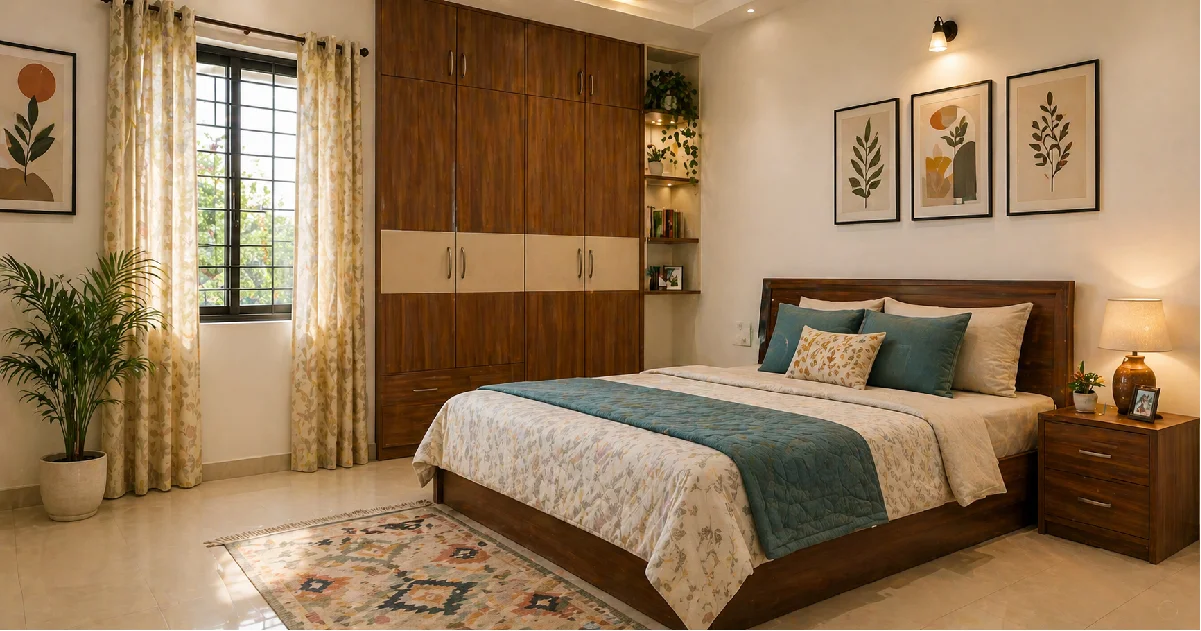
Most Indian bedroom design content online is either copied from Pinterest boards that belong to a different country or written assuming you have a budget that most salaried families in Bangalore would question. The reality of middle-class Indian bedroom design is messier, more interesting, and frankly more solvable than those aesthetics make it seem.
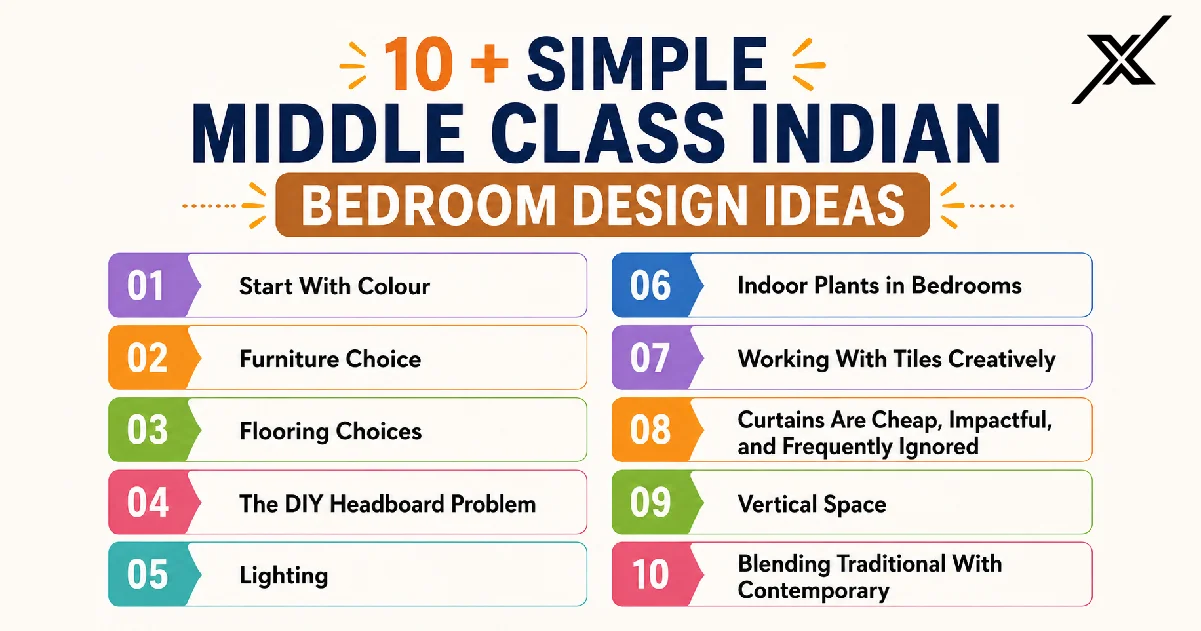
Let’s talk about some cool bedroom design ideas that will fit in your budget and mood.
1. Start With Colour
Everyone tells you to go beige or white for small Indian bedrooms, and there's a reason for that; it works. Light walls reflect more of the limited natural light that comes through your one or two windows, and they make furniture stand out cleanly instead of competing with the walls.
But pure white is actually harder to maintain in Indian conditions. Dust, fingerprints near light switches, and that faint yellow that develops in rooms with insufficient ventilation all show more on stark white walls. A warm off-white, something with a slight cream or stone undertone, holds up better and feels less clinical.
If you want color, use it deliberately. One accent wall, the wall behind your bed, is enough. A muted terracotta, a dusty olive green, or a deep slate blue on that one wall gives the room personality without making it feel smaller. The other three walls stay light.
The mistake most people make is painting all four walls in a colour they loved in a swatch but found overwhelming at full scale.
2. Furniture Choice
Ten years ago, modular furniture was an Ikea concept that didn't quite translate to Indian homes. Things have changed. There are now solid local and regional brands, including several in Bangalore's Whitefield and Koramangala showroom belts, that offer hydraulic storage beds, wall-mounted desks, and pull-out wardrobes at prices that genuinely make sense.
A hydraulic bed with under-mattress storage is probably the single most useful piece of furniture you can buy for a middle-class Indian home. The amount of space you get under there, for seasonal clothes, extra pillows, and rarely used luggage, is significant. You're essentially adding a small storage room to your bedroom.
Pair that with a wall-mounted shelf unit instead of a traditional free-standing bookcase, and your floor looks considerably more open. Open floor space reads as larger rooms do. It's not a trick; it's just how the eye processes space.
3. Flooring Choices
Indian bedrooms have historically used either plain vitrified tiles or ceramic tiles with forgettable patterns from the early 2000s. That's changed considerably. Wood-finish vitrified tiles are now widely available, cost a fraction of actual hardwood flooring, and are dramatically easier to maintain, important in a city like Bangalore, where humidity fluctuates and actual wood can warp.
The texture and warmth that wood-finish tiles bring to a bedroom is real. It softens the room visually, making it feel less like a furnished box and more like an actual living space. Pair this with a small area rug near the bed, even a basic cotton dhurrie works, and the room gains a layer of tactile warmth that most people underestimate.
If your bedroom is tiled with those dated off-white tiles with hairline pattern borders, you don't necessarily need to retile the entire floor. A well-placed rug over most of the visible area near the bed can effectively neutralize what's underneath. That's a cheaper interim fix while you plan properly.
4. The DIY Headboard Problem
DIY headboards look genuinely good in photographs. In practice, unless you have some woodworking ability or know someone who does, fabric panel headboards tend to sag, MDF ones chip at the edges, and the whole thing ends up looking like a failed Pinterest project six months in.
A more reliable approach: use the wall behind the bed as your design feature, not a physical headboard. A carefully painted accent wall, wallpaper on a single panel, or textured stone-finish cladding on the bed wall achieves the same visual anchoring effect without the upkeep issues.
The other thing that works surprisingly well, and almost no one talks about it — is a large, framed mirror positioned off-centre on the wall beside the bed, not behind it. It reflects the window light, makes the room feel less closed-in, and adds a design element that's functional too.
5. Lighting
Most Indian bedrooms have one overhead tube light or a single CFL fixture in the center of the ceiling, and that's it. It creates flat, harsh light that makes the room look like a government office. It also does absolutely nothing for relaxation.
Layered lighting isn't complicated. You need three things:
The main overhead light for when you need to see clearly, switching to a warm LED (around 3000K colour temperature) instead of cool white changes the feel of the room immediately and costs almost nothing.
A bedside lamp or wall sconce for reading. Clip-on reading lights from local markets work fine. Wall-mounted sconces are better aesthetically because they free up the bedside table surface.
Some form of accent lighting, LED strips behind a floating shelf, or under-bed LED lighting that's more subtle than it sounds, adds depth to the room after dark without requiring much effort or expense.
This is genuinely where the biggest transformation happens per rupee spent. A bedroom with good layered lighting at night looks like it's been designed by someone who knows what they're doing, even if everything else is basic.
6. Indoor Plants in Bedrooms
Snake plants, pothos, and peace lilies are the standard recommendations for Indian bedroom plants, and they're recommended repeatedly because they genuinely work. They're tolerant of low light, inconsistent watering, and the kind of irregular care that most working adults can realistically provide.
What doesn't get mentioned enough: the placement matters. Near a window, these plants thrive. Tucked in a dark corner because it "looks good there", they struggle and eventually look sad, which defeats the purpose.
If your room doesn't get natural light, you have two options: rotate plants out every few weeks (bring them to a brighter space, return them when they've recovered), or switch to high-quality artificial plants in that corner. There's no real shame in artificial plants if the maintenance isn't realistic for your lifestyle. An artificial monstera that looks genuinely healthy is better than a real one that's half-dying.
7. Working With Tiles Creatively
Most people think of tiles as something that goes on floors and bathroom walls. But in a Bangalore apartment where plastered walls sometimes have quality issues, using tiles on a small section of your bedroom wall, say, as a backdrop to a floating shelf unit or as a niche feature, is both practical and visually interesting.
This works especially well with textured or matte-finish tiles in natural tones. It's not about covering the whole wall. A 2-foot-wide, floor-to-ceiling strip of tile alongside a reading corner or beside a wardrobe creates a clean, architectural element that looks considered rather than accidental.
The cost is manageable because you're working with a small area, and the result is more durable than paint in that section too.
8. Curtains Are Cheap, Impactful, and Frequently Ignored
Curtains and drapes get treated as an afterthought in most Indian home setups. You pick them up from a local textile shop, they serve a functional purpose, end of story.
But the curtain height matters enormously. If you hang curtains from the actual window frame instead of from close to the ceiling, the room looks shorter and more cramped. Hang your curtain rod as close to the ceiling as possible, and use floor-length curtains even for windows that sit at mid-wall height. The vertical drop creates an illusion of height that works in smaller rooms.
For Bangalore's climate, which runs cooler and damper than Mumbai or Chennai, cotton curtains are more practical than the heavy polyester ones that dominate most budget ranges. They move better, don't trap dust as aggressively, and look less stiff.
Cushion covers are the cheapest rotating decor element you have. Changing them seasonally costs very little and updates the room's colour story without requiring any actual renovation.
9. Vertical Space
A standard Indian bedroom uses maybe 40% of its available wall height for storage. Everything sits on the floor or on low furniture, and the top two feet of wall above the wardrobe, sometimes three feet, is just empty.
Floating shelves installed above the wardrobe height, or a custom upper cabinet above a standard wardrobe unit, gives you meaningful storage for infrequently used items: extra bedsheets, old documents, and boxes of items that don't need daily access.
The same logic applies behind the door. A set of hooks or a slim over-door organizer on the back of the bedroom door captures a lot of small items, bags, belts, and the kurta you plan to wear again before washing, that otherwise end up on the chair or the bed edge and contribute to the cluttered feeling that makes a room feel smaller than it is.
10. Blending Traditional With Contemporary
This is more of a personal design challenge than a technical one. Most middle-class Indian households have some inherited furniture, a teak chest, a carved wooden frame, an old brass lamp, and the question is whether to use it or box it away in favor of a more consistent modern look.
The honest answer: a single traditional element in an otherwise contemporary room almost always looks intentional and good. It suggests that someone curated the space rather than ordered everything from one catalog. The problem is when too many heirlooms compete with the modern furniture, and the room ends up looking like a storage space rather than a designed one.
Pick one or two pieces. A carved wooden mirror frame on the accent wall. A brass lamp repurposed as a bedside light. A traditional kantha throw on the bed. These things read as a layered personality, not inconsistency, as long as the surrounding furniture is relatively restrained.
11. Sliding Wardrobes
In a room where the wardrobe takes up a full wall, which is common in Bangalore 2 BHK configurations, swing doors that open outward take away the floor space that makes the room livable. You're effectively unable to use the area in front of the wardrobe without constantly moving around the open doors.
Sliding doors solve this completely. The bedroom feels larger because the movement zone in front of the wardrobe doesn't change when you access it. Mirrored sliding doors compound this benefit, the reflection doubles the apparent depth of the room and handles the large mirror requirement simultaneously.
For budget options, MDF sliding wardrobes with basic laminate finishes are widely available. They're not as premium-feeling as German hardware systems, but they're functional, last well, and don't demand the kind of investment that strains a household budget.
12. A Floor Seating Corner: Both Practical and Underrated
This is one of those ideas that tends to get dismissed as a design trend before people actually try it. A corner of the bedroom with a small dhurrie rug, two or three large floor cushions, and a low kadappa or wooden table functions as a reading nook, a place to sit when folding laundry, a casual conversation space, and — when relatives visit — a comfortable spot that doesn't require pulling up chairs.
It connects with Indian floor-sitting culture in a way that bean bags (often uncomfortable after the first month) and low armchairs (often too expensive) don't. And it costs very little compared to any other furniture purchase.
If there's a child in the home, this corner also functions as their space within the bedroom without needing a separate piece of furniture. Add a small toy storage unit nearby, and the corner has its own defined zone.
13. The Ceiling Is Not Neutral Do Something With It
A plain ceiling fan on a white slab ceiling is the default, and it's not inspiring. False ceilings are the aspirational upgrade, but they're not always feasible in the budget, and in some older Bangalore apartments with lower floor-to-ceiling heights, they actively shrink the room.
The middle ground: a ceiling border. A simple painted border, 4 to 6 inches wide, in a colour that pulls from the rest of the room's palette, runs along the perimeter of the ceiling and creates a framing effect that suggests detail without requiring any false ceiling work. It costs almost nothing and is completely reversible.
A ceiling medallion around the fan fixture is another low-effort, low-cost option. They're
Conclusion
A well-designed bedroom in a middle-class Indian home doesn't happen in one renovation cycle. It's accumulated, one smart furniture decision, one well-placed lamp, and one wall that finally gets the colour it deserved. To make these decisions accurately, you need the best interior designers in Bangalore, who help you achieve all your dreams for your bedroom design. The homes that look genuinely put-together aren't always the ones that spent the most. They're the ones where someone paid attention.
The ideas above are a starting point, not a checklist. Not all of them will suit your space or your household. But most of them cost less than people expect and deliver more than they anticipate. Don’t get confused because you just have to tell your mood and vibe; everything else will be taken care of by interior designers in Bangalore.
Most Indian bedroom design content online is either copied from Pinterest boards that belong to a different country or written assuming you have a budget that most salaried families in Bangalore would question. The reality of middle-class Indian bedroom design is messier, more interesting, and frankly more solvable than those aesthetics make it seem.
Let’s talk about some cool bedroom design ideas that will fit in your budget and mood.
1. Start With Colour
Everyone tells you to go beige or white for small Indian bedrooms, and there's a reason for that; it works. Light walls reflect more of the limited natural light that comes through your one or two windows, and they make furniture stand out cleanly instead of competing with the walls.
But pure white is actually harder to maintain in Indian conditions. Dust, fingerprints near light switches, and that faint yellow that develops in rooms with insufficient ventilation all show more on stark white walls. A warm off-white, something with a slight cream or stone undertone, holds up better and feels less clinical.
If you want color, use it deliberately. One accent wall, the wall behind your bed, is enough. A muted terracotta, a dusty olive green, or a deep slate blue on that one wall gives the room personality without making it feel smaller. The other three walls stay light.
The mistake most people make is painting all four walls in a colour they loved in a swatch but found overwhelming at full scale.
2. Furniture Choice
Ten years ago, modular furniture was an Ikea concept that didn't quite translate to Indian homes. Things have changed. There are now solid local and regional brands, including several in Bangalore's Whitefield and Koramangala showroom belts, that offer hydraulic storage beds, wall-mounted desks, and pull-out wardrobes at prices that genuinely make sense.
A hydraulic bed with under-mattress storage is probably the single most useful piece of furniture you can buy for a middle-class Indian home. The amount of space you get under there, for seasonal clothes, extra pillows, and rarely used luggage, is significant. You're essentially adding a small storage room to your bedroom.
Pair that with a wall-mounted shelf unit instead of a traditional free-standing bookcase, and your floor looks considerably more open. Open floor space reads as larger rooms do. It's not a trick; it's just how the eye processes space.
3. Flooring Choices
Indian bedrooms have historically used either plain vitrified tiles or ceramic tiles with forgettable patterns from the early 2000s. That's changed considerably. Wood-finish vitrified tiles are now widely available, cost a fraction of actual hardwood flooring, and are dramatically easier to maintain, important in a city like Bangalore, where humidity fluctuates and actual wood can warp.
The texture and warmth that wood-finish tiles bring to a bedroom is real. It softens the room visually, making it feel less like a furnished box and more like an actual living space. Pair this with a small area rug near the bed, even a basic cotton dhurrie works, and the room gains a layer of tactile warmth that most people underestimate.
If your bedroom is tiled with those dated off-white tiles with hairline pattern borders, you don't necessarily need to retile the entire floor. A well-placed rug over most of the visible area near the bed can effectively neutralize what's underneath. That's a cheaper interim fix while you plan properly.
4. The DIY Headboard Problem
DIY headboards look genuinely good in photographs. In practice, unless you have some woodworking ability or know someone who does, fabric panel headboards tend to sag, MDF ones chip at the edges, and the whole thing ends up looking like a failed Pinterest project six months in.
A more reliable approach: use the wall behind the bed as your design feature, not a physical headboard. A carefully painted accent wall, wallpaper on a single panel, or textured stone-finish cladding on the bed wall achieves the same visual anchoring effect without the upkeep issues.
The other thing that works surprisingly well, and almost no one talks about it — is a large, framed mirror positioned off-centre on the wall beside the bed, not behind it. It reflects the window light, makes the room feel less closed-in, and adds a design element that's functional too.
5. Lighting
Most Indian bedrooms have one overhead tube light or a single CFL fixture in the center of the ceiling, and that's it. It creates flat, harsh light that makes the room look like a government office. It also does absolutely nothing for relaxation.
Layered lighting isn't complicated. You need three things:
The main overhead light for when you need to see clearly, switching to a warm LED (around 3000K colour temperature) instead of cool white changes the feel of the room immediately and costs almost nothing.
A bedside lamp or wall sconce for reading. Clip-on reading lights from local markets work fine. Wall-mounted sconces are better aesthetically because they free up the bedside table surface.
Some form of accent lighting, LED strips behind a floating shelf, or under-bed LED lighting that's more subtle than it sounds, adds depth to the room after dark without requiring much effort or expense.
This is genuinely where the biggest transformation happens per rupee spent. A bedroom with good layered lighting at night looks like it's been designed by someone who knows what they're doing, even if everything else is basic.
6. Indoor Plants in Bedrooms
Snake plants, pothos, and peace lilies are the standard recommendations for Indian bedroom plants, and they're recommended repeatedly because they genuinely work. They're tolerant of low light, inconsistent watering, and the kind of irregular care that most working adults can realistically provide.
What doesn't get mentioned enough: the placement matters. Near a window, these plants thrive. Tucked in a dark corner because it "looks good there", they struggle and eventually look sad, which defeats the purpose.
If your room doesn't get natural light, you have two options: rotate plants out every few weeks (bring them to a brighter space, return them when they've recovered), or switch to high-quality artificial plants in that corner. There's no real shame in artificial plants if the maintenance isn't realistic for your lifestyle. An artificial monstera that looks genuinely healthy is better than a real one that's half-dying.
7. Working With Tiles Creatively
Most people think of tiles as something that goes on floors and bathroom walls. But in a Bangalore apartment where plastered walls sometimes have quality issues, using tiles on a small section of your bedroom wall, say, as a backdrop to a floating shelf unit or as a niche feature, is both practical and visually interesting.
This works especially well with textured or matte-finish tiles in natural tones. It's not about covering the whole wall. A 2-foot-wide, floor-to-ceiling strip of tile alongside a reading corner or beside a wardrobe creates a clean, architectural element that looks considered rather than accidental.
The cost is manageable because you're working with a small area, and the result is more durable than paint in that section too.
8. Curtains Are Cheap, Impactful, and Frequently Ignored
Curtains and drapes get treated as an afterthought in most Indian home setups. You pick them up from a local textile shop, they serve a functional purpose, end of story.
But the curtain height matters enormously. If you hang curtains from the actual window frame instead of from close to the ceiling, the room looks shorter and more cramped. Hang your curtain rod as close to the ceiling as possible, and use floor-length curtains even for windows that sit at mid-wall height. The vertical drop creates an illusion of height that works in smaller rooms.
For Bangalore's climate, which runs cooler and damper than Mumbai or Chennai, cotton curtains are more practical than the heavy polyester ones that dominate most budget ranges. They move better, don't trap dust as aggressively, and look less stiff.
Cushion covers are the cheapest rotating decor element you have. Changing them seasonally costs very little and updates the room's colour story without requiring any actual renovation.
9. Vertical Space
A standard Indian bedroom uses maybe 40% of its available wall height for storage. Everything sits on the floor or on low furniture, and the top two feet of wall above the wardrobe, sometimes three feet, is just empty.
Floating shelves installed above the wardrobe height, or a custom upper cabinet above a standard wardrobe unit, gives you meaningful storage for infrequently used items: extra bedsheets, old documents, and boxes of items that don't need daily access.
The same logic applies behind the door. A set of hooks or a slim over-door organizer on the back of the bedroom door captures a lot of small items, bags, belts, and the kurta you plan to wear again before washing, that otherwise end up on the chair or the bed edge and contribute to the cluttered feeling that makes a room feel smaller than it is.
10. Blending Traditional With Contemporary
This is more of a personal design challenge than a technical one. Most middle-class Indian households have some inherited furniture, a teak chest, a carved wooden frame, an old brass lamp, and the question is whether to use it or box it away in favor of a more consistent modern look.
The honest answer: a single traditional element in an otherwise contemporary room almost always looks intentional and good. It suggests that someone curated the space rather than ordered everything from one catalog. The problem is when too many heirlooms compete with the modern furniture, and the room ends up looking like a storage space rather than a designed one.
Pick one or two pieces. A carved wooden mirror frame on the accent wall. A brass lamp repurposed as a bedside light. A traditional kantha throw on the bed. These things read as a layered personality, not inconsistency, as long as the surrounding furniture is relatively restrained.
11. Sliding Wardrobes
In a room where the wardrobe takes up a full wall, which is common in Bangalore 2 BHK configurations, swing doors that open outward take away the floor space that makes the room livable. You're effectively unable to use the area in front of the wardrobe without constantly moving around the open doors.
Sliding doors solve this completely. The bedroom feels larger because the movement zone in front of the wardrobe doesn't change when you access it. Mirrored sliding doors compound this benefit, the reflection doubles the apparent depth of the room and handles the large mirror requirement simultaneously.
For budget options, MDF sliding wardrobes with basic laminate finishes are widely available. They're not as premium-feeling as German hardware systems, but they're functional, last well, and don't demand the kind of investment that strains a household budget.
12. A Floor Seating Corner: Both Practical and Underrated
This is one of those ideas that tends to get dismissed as a design trend before people actually try it. A corner of the bedroom with a small dhurrie rug, two or three large floor cushions, and a low kadappa or wooden table functions as a reading nook, a place to sit when folding laundry, a casual conversation space, and — when relatives visit — a comfortable spot that doesn't require pulling up chairs.
It connects with Indian floor-sitting culture in a way that bean bags (often uncomfortable after the first month) and low armchairs (often too expensive) don't. And it costs very little compared to any other furniture purchase.
If there's a child in the home, this corner also functions as their space within the bedroom without needing a separate piece of furniture. Add a small toy storage unit nearby, and the corner has its own defined zone.
13. The Ceiling Is Not Neutral Do Something With It
A plain ceiling fan on a white slab ceiling is the default, and it's not inspiring. False ceilings are the aspirational upgrade, but they're not always feasible in the budget, and in some older Bangalore apartments with lower floor-to-ceiling heights, they actively shrink the room.
The middle ground: a ceiling border. A simple painted border, 4 to 6 inches wide, in a colour that pulls from the rest of the room's palette, runs along the perimeter of the ceiling and creates a framing effect that suggests detail without requiring any false ceiling work. It costs almost nothing and is completely reversible.
A ceiling medallion around the fan fixture is another low-effort, low-cost option. They're
Conclusion
A well-designed bedroom in a middle-class Indian home doesn't happen in one renovation cycle. It's accumulated, one smart furniture decision, one well-placed lamp, and one wall that finally gets the colour it deserved. To make these decisions accurately, you need the best interior designers in Bangalore, who help you achieve all your dreams for your bedroom design. The homes that look genuinely put-together aren't always the ones that spent the most. They're the ones where someone paid attention.
The ideas above are a starting point, not a checklist. Not all of them will suit your space or your household. But most of them cost less than people expect and deliver more than they anticipate. Don’t get confused because you just have to tell your mood and vibe; everything else will be taken care of by interior designers in Bangalore.
Let's
Build
something
enduring
Every exceptional space begins with a conversation. We'd be honored to learn about your vision.
Let's
Build
something
enduring
Every exceptional space begins with a conversation. We'd be honored to learn about your vision.
Let's
Build
something
enduring
Every exceptional space begins with a conversation. We'd be honored to learn about your vision.