
Walk into a new home in Bangalore, Mumbai, or Delhi these days, and you'll notice something different. Lights turn on as you walk in. Curtains close on their own when the sun gets too bright. One voice command switches off everything before you go to sleep.
Smart homes aren't just a movie thing anymore. They're slowly becoming normal in Indian homes, and 2026 looks like the year this really picks up pace.
If you're planning to build or renovate your home, here's a simple guide to what smart home design looks like in 2026, and how you can plan for it.
What Does "Smart Home" Really Mean?
A lot of people think smart homes are just about buying gadgets and placing them around the house. But that's not quite right.
A smart home is really about planning your interiors so that these devices fit in naturally and actually make life easier, not more complicated. A well-designed smart home should feel almost invisible. No messy wires, no odd-looking panels stuck on walls. Things just work quietly in the background.
That's why smart features need to be thought about early, while you're still planning your interiors, not after everything is built. Your electrician, your designer, and anyone setting up the automation should all be talking to each other from the start.
Why 2026 Feels Like the Right Time
A few things are happening together that make this the right moment to think about smart homes.
Smart devices are a lot cheaper than they used to be. What once felt like a luxury now fits into a normal renovation budget.
More Indian brands are making smart products built for Indian homes, with our voltage, our plugs, and even support for Indian languages. This makes them much easier to use day to day.
Younger homeowners, especially first-time buyers in cities like Bangalore, have grown up with smartphones and apps for everything. For them, a smart home doesn't feel like something extra. It feels normal.
Builders are also catching up. Many new projects now come "smart-ready," meaning the wiring for automation is already there, so owners can add devices later without breaking walls or redoing electrical work.
Smart Home Ideas Worth Considering in 2026
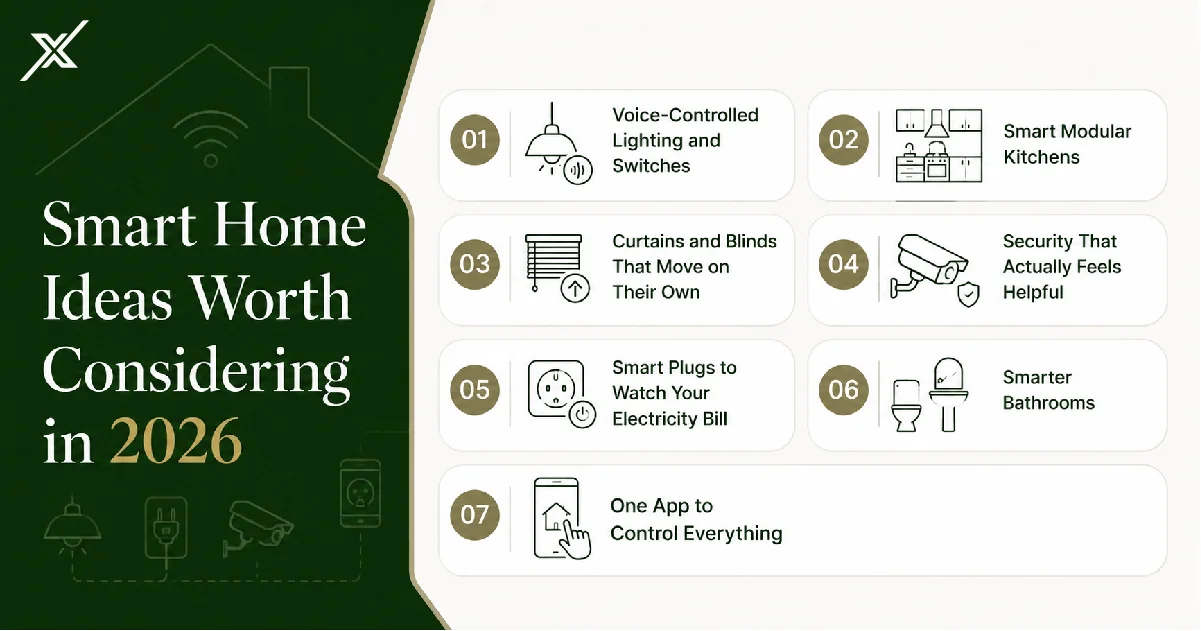
1. Voice-Controlled Lighting and Switches
This is the easiest place to start. Instead of getting up to switch off the fan or dim a light, you just say it out loud.
For Indian homes, this is especially handy in bedrooms. No more getting out of bed to check if you switched off the lights. Just say "turn off all lights" and you're done.
The trick is to plan this during your electrical work. Smart switches can sit behind your normal switchboards, so your home still looks the same but works a lot smarter.
2. Smart Modular Kitchens
Kitchens are getting some nice upgrades too. Think taps that turn on when you wave your hand near them, chimneys you can control from your phone, and under-cabinet lights that switch on automatically when you open a drawer.
For busy households, especially when both partners are working, these little things save a surprising amount of time and effort every day.
If you're getting a modular kitchen done, talk to your designer about these options early, since the wiring and plumbing need to be planned with this in mind.
3. Curtains and Blinds That Move on Their Own
This one is becoming popular fast, especially in homes that get strong sunlight. Motorized curtains can open and close on their own, based on the time of day or how bright it is outside.
For Bangalore homes facing busy roads or harsh afternoon sun, this means your living room stays cooler and more private, without anyone having to run around closing curtains.
The good news is that many of these can be added to your existing curtain tracks, so you don't always need a full window makeover.
4. Security That Actually Feels Helpful
Home security has moved way beyond just CCTV. Now you can get video doorbells that let you see and talk to whoever's at your door, even when you're not home. Smart locks let you give temporary codes to house help, guests, or delivery people. And motion sensors can alert you if something unusual happens while you're away.
For working couples, parents living alone, or homes with small kids, this kind of setup gives a real sense of peace, not just a fancy gadget to show off.
5. Smart Plugs to Watch Your Electricity Bill
With electricity bills going up, smart plugs and energy monitors are becoming popular. They let you see exactly how much power each appliance is using, and you can switch things off from your phone if you forgot.
This is especially useful for things like geysers, ACs, and washing machines, which can quietly run up your bill if left on by mistake.
6. Smarter Bathrooms
Even bathrooms are getting an upgrade. Mirrors with built-in lights, anti-fog features, and small displays for time or weather are becoming common in newer homes.
Add sensor-based taps and smart exhaust fans, and your bathroom becomes a lot more hygienic and low-maintenance, without much extra effort on your part.
7. One App to Control Everything
Instead of juggling ten different apps for ten different devices, more homes are now moving to one central app or hub. From here, you can control lights, fans, ACs, and security cameras, all in one place.
This matters a lot for Indian families, because it makes the whole system simple enough for everyone at home to use, including parents or grandparents who aren't too comfortable with technology.
How to Plan for Smart Features in Your Home
If you're renovating or building, here's a simple way to approach it.
Start small. You don't need to automate everything at once. Lighting, fans, and basic security are a good starting point, since they give you the most benefit for a reasonable cost.
Loop in your designer and electrician together, right from the planning stage. The wiring for smart features needs to go in before walls are closed and ceilings are done.
Keep your wiring flexible. Even if you're not adding every smart feature now, it's smart to lay a few extra wires or conduits, so you can add devices later without breaking anything open again.
Check if devices work together. Before buying anything, make sure the products you choose can talk to each other and work with the voice assistant you plan to use.
Don't forget how it looks. Smart devices should blend into your home, not stick out awkwardly. Hidden wiring and clean switchboards make a big difference in how polished your home feels.
Will a Smart Home Cost Me a Lot?
This depends entirely on how much you want to do. The honest answer is, it doesn't have to be expensive.
Basic smart lighting or a few smart plugs can fit into almost any renovation budget. A fully automated home with smart curtains, security, and one central control system will obviously cost more.
The good thing is that smart home technology is flexible. You can start with just one or two features and add more later as your budget allows. Your designer can help you plan the wiring now, so you're ready to add more whenever you're ready.
Conclusion
Smart home interior design in 2026 isn't about turning your house into something out of a sci-fi movie. The best interior designers in bangalore are here for making everyday life a bit easier, safer, and more comfortable, while your home still looks and feels like home.
For Indian homeowners, especially in busy cities like Bangalore, things like voice-controlled lighting, automated curtains, smarter security, and energy monitoring are slowly becoming normal additions, not just luxury extras.
The most important thing is to plan early with home interior designers in bangalore, If you're building or renovating, have that conversation with your designer and electrician about smart wiring right from the start. Even if you don't add everything right away, having the right setup in place will make it much easier to upgrade your home as smart technology keeps getting better in 2026 and the years ahead.
Walk into a new home in Bangalore, Mumbai, or Delhi these days, and you'll notice something different. Lights turn on as you walk in. Curtains close on their own when the sun gets too bright. One voice command switches off everything before you go to sleep.
Smart homes aren't just a movie thing anymore. They're slowly becoming normal in Indian homes, and 2026 looks like the year this really picks up pace.
If you're planning to build or renovate your home, here's a simple guide to what smart home design looks like in 2026, and how you can plan for it.
What Does "Smart Home" Really Mean?
A lot of people think smart homes are just about buying gadgets and placing them around the house. But that's not quite right.
A smart home is really about planning your interiors so that these devices fit in naturally and actually make life easier, not more complicated. A well-designed smart home should feel almost invisible. No messy wires, no odd-looking panels stuck on walls. Things just work quietly in the background.
That's why smart features need to be thought about early, while you're still planning your interiors, not after everything is built. Your electrician, your designer, and anyone setting up the automation should all be talking to each other from the start.
Why 2026 Feels Like the Right Time
A few things are happening together that make this the right moment to think about smart homes.
Smart devices are a lot cheaper than they used to be. What once felt like a luxury now fits into a normal renovation budget.
More Indian brands are making smart products built for Indian homes, with our voltage, our plugs, and even support for Indian languages. This makes them much easier to use day to day.
Younger homeowners, especially first-time buyers in cities like Bangalore, have grown up with smartphones and apps for everything. For them, a smart home doesn't feel like something extra. It feels normal.
Builders are also catching up. Many new projects now come "smart-ready," meaning the wiring for automation is already there, so owners can add devices later without breaking walls or redoing electrical work.
Smart Home Ideas Worth Considering in 2026
1. Voice-Controlled Lighting and Switches
This is the easiest place to start. Instead of getting up to switch off the fan or dim a light, you just say it out loud.
For Indian homes, this is especially handy in bedrooms. No more getting out of bed to check if you switched off the lights. Just say "turn off all lights" and you're done.
The trick is to plan this during your electrical work. Smart switches can sit behind your normal switchboards, so your home still looks the same but works a lot smarter.
2. Smart Modular Kitchens
Kitchens are getting some nice upgrades too. Think taps that turn on when you wave your hand near them, chimneys you can control from your phone, and under-cabinet lights that switch on automatically when you open a drawer.
For busy households, especially when both partners are working, these little things save a surprising amount of time and effort every day.
If you're getting a modular kitchen done, talk to your designer about these options early, since the wiring and plumbing need to be planned with this in mind.
3. Curtains and Blinds That Move on Their Own
This one is becoming popular fast, especially in homes that get strong sunlight. Motorized curtains can open and close on their own, based on the time of day or how bright it is outside.
For Bangalore homes facing busy roads or harsh afternoon sun, this means your living room stays cooler and more private, without anyone having to run around closing curtains.
The good news is that many of these can be added to your existing curtain tracks, so you don't always need a full window makeover.
4. Security That Actually Feels Helpful
Home security has moved way beyond just CCTV. Now you can get video doorbells that let you see and talk to whoever's at your door, even when you're not home. Smart locks let you give temporary codes to house help, guests, or delivery people. And motion sensors can alert you if something unusual happens while you're away.
For working couples, parents living alone, or homes with small kids, this kind of setup gives a real sense of peace, not just a fancy gadget to show off.
5. Smart Plugs to Watch Your Electricity Bill
With electricity bills going up, smart plugs and energy monitors are becoming popular. They let you see exactly how much power each appliance is using, and you can switch things off from your phone if you forgot.
This is especially useful for things like geysers, ACs, and washing machines, which can quietly run up your bill if left on by mistake.
6. Smarter Bathrooms
Even bathrooms are getting an upgrade. Mirrors with built-in lights, anti-fog features, and small displays for time or weather are becoming common in newer homes.
Add sensor-based taps and smart exhaust fans, and your bathroom becomes a lot more hygienic and low-maintenance, without much extra effort on your part.
7. One App to Control Everything
Instead of juggling ten different apps for ten different devices, more homes are now moving to one central app or hub. From here, you can control lights, fans, ACs, and security cameras, all in one place.
This matters a lot for Indian families, because it makes the whole system simple enough for everyone at home to use, including parents or grandparents who aren't too comfortable with technology.
How to Plan for Smart Features in Your Home
If you're renovating or building, here's a simple way to approach it.
Start small. You don't need to automate everything at once. Lighting, fans, and basic security are a good starting point, since they give you the most benefit for a reasonable cost.
Loop in your designer and electrician together, right from the planning stage. The wiring for smart features needs to go in before walls are closed and ceilings are done.
Keep your wiring flexible. Even if you're not adding every smart feature now, it's smart to lay a few extra wires or conduits, so you can add devices later without breaking anything open again.
Check if devices work together. Before buying anything, make sure the products you choose can talk to each other and work with the voice assistant you plan to use.
Don't forget how it looks. Smart devices should blend into your home, not stick out awkwardly. Hidden wiring and clean switchboards make a big difference in how polished your home feels.
Will a Smart Home Cost Me a Lot?
This depends entirely on how much you want to do. The honest answer is, it doesn't have to be expensive.
Basic smart lighting or a few smart plugs can fit into almost any renovation budget. A fully automated home with smart curtains, security, and one central control system will obviously cost more.
The good thing is that smart home technology is flexible. You can start with just one or two features and add more later as your budget allows. Your designer can help you plan the wiring now, so you're ready to add more whenever you're ready.
Conclusion
Smart home interior design in 2026 isn't about turning your house into something out of a sci-fi movie. The best interior designers in bangalore are here for making everyday life a bit easier, safer, and more comfortable, while your home still looks and feels like home.
For Indian homeowners, especially in busy cities like Bangalore, things like voice-controlled lighting, automated curtains, smarter security, and energy monitoring are slowly becoming normal additions, not just luxury extras.
The most important thing is to plan early with home interior designers in bangalore, If you're building or renovating, have that conversation with your designer and electrician about smart wiring right from the start. Even if you don't add everything right away, having the right setup in place will make it much easier to upgrade your home as smart technology keeps getting better in 2026 and the years ahead.
Let's
Build
something
enduring
Every exceptional space begins with a conversation. We'd be honored to learn about your vision.
Let's
Build
something
enduring
Every exceptional space begins with a conversation. We'd be honored to learn about your vision.
Let's
Build
something
enduring
Every exceptional space begins with a conversation. We'd be honored to learn about your vision.